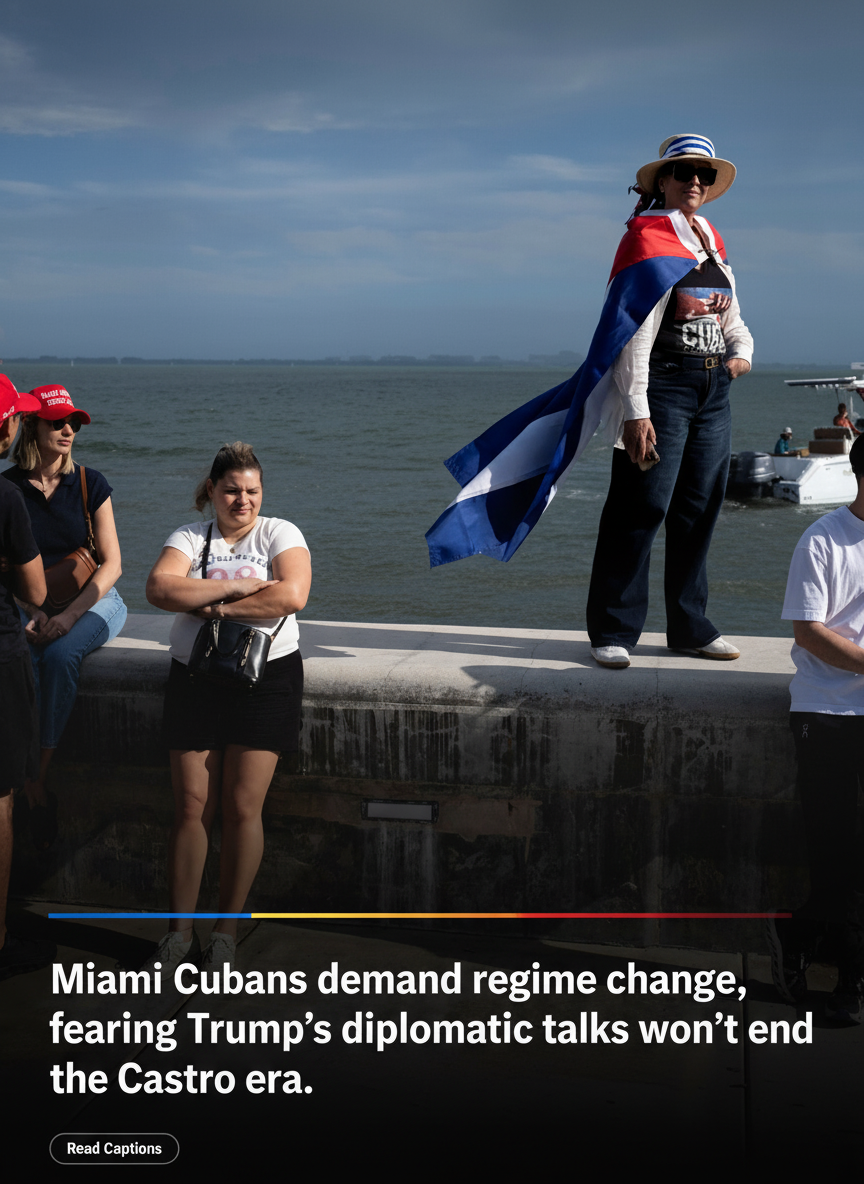
Miami Cubans Fear Trump Won’t Go Far Enough: ‘The Castros Have to Go’
By Political Correspondent | March 17, 2026
A Community on Edge
MIAMI, FL — For decades, the Calle Ocho district of Little Havana has been the heartbeat of the Cuban exile movement, a place where the dream of a free Cuba is preserved in coffee windows and domino parks. But this week, that heartbeat has quickened into a rhythm of anxiety and skepticism. As President Trump’s administration enters a new round of high-stakes diplomatic talks with the Cuban government, the very constituency that helped propel him back to the White House is sounding an alarm.
The sentiment across South Florida is clear: many Cuban Americans fear that the President, known for his “art of the deal,” may be settling for a pragmatic economic arrangement rather than the wholesale political transformation they have demanded for over sixty years. “The Castros have to go—not just the name, but the entire system,” said Jorge Alvarez, 74, a veteran of the Bay of Pigs era. “We didn’t vote for a better trade deal. We voted for a free Cuba.”
The Shift from “Maximum Pressure” to Diplomacy
During his previous term and the early days of his return to office, President Trump maintained a policy of “maximum pressure,” tightening sanctions and designating Cuba as a state sponsor of terrorism. However, the 2026 landscape has shifted. Facing a migrant crisis at the Florida straits and a growing Russian and Chinese naval presence in the Caribbean, the administration has pivoted toward direct engagement.
White House officials suggest that opening a dialogue could provide the leverage needed to loosen the Communist Party’s grip on the island. Yet, for many in Miami, any talk that doesn’t lead to immediate multiparty elections and the release of all political prisoners is viewed as a betrayal. The fear is that Trump’s penchant for bilateral deals might result in a “Vietnam model”—economic liberalization without political freedom—leaving the existing power structure in Havana intact.
Political Stakes in the Sunshine State
The timing of the unrest is particularly sensitive. Florida remains a vital political stronghold, and the Cuban-American vote is its cornerstone. Local leaders warn that if the administration is perceived as “softening” on the regime, the political cost could be high. Representative Mario Díaz-Balart and other prominent Cuban-American voices in Congress have already signaled they will scrutinize any concessions made during the talks.
“The President needs to remember who his friends are,” said Sylvia Rodriguez, a community organizer in Hialeah. “We have seen these ‘thaws’ before under Obama, and all they did was line the pockets of the generals in Havana. We expect President Trump to hold the line. Freedom is not a bargaining chip.”
The “Castroism” Without Castros
While the physical presence of the Castro brothers has faded from the front lines of Cuban politics, the “Castroist” ideology and the military-run conglomerate, GAESA, continue to dominate the island’s economy. Protesters in Miami argue that as long as the military controls the hotels and the ports, any American investment serves only to fortify the dictatorship.
The administration has countered these fears by insisting that “all options remain on the table,” including the snapback of sanctions if the Cuban government fails to meet human rights benchmarks. However, the specific benchmarks remain a point of contention. Miami’s hardliners argue that anything short of the total dismantling of the Communist Party is a failure of leadership.
Conclusion
As the sun sets over the Freedom Tower in Miami, the community remains in a state of watchful waiting. The talks in Havana are scheduled to continue through the end of the month, and the eyes of South Florida are fixed firmly on the White House. For President Trump, the challenge will be to balance the strategic interests of the United States with the deep-seated emotional and political demands of a community that refuses to accept anything less than total liberation. In Little Havana, the message remains unchanged: a deal is only a good deal if it leads to the end of the regime.