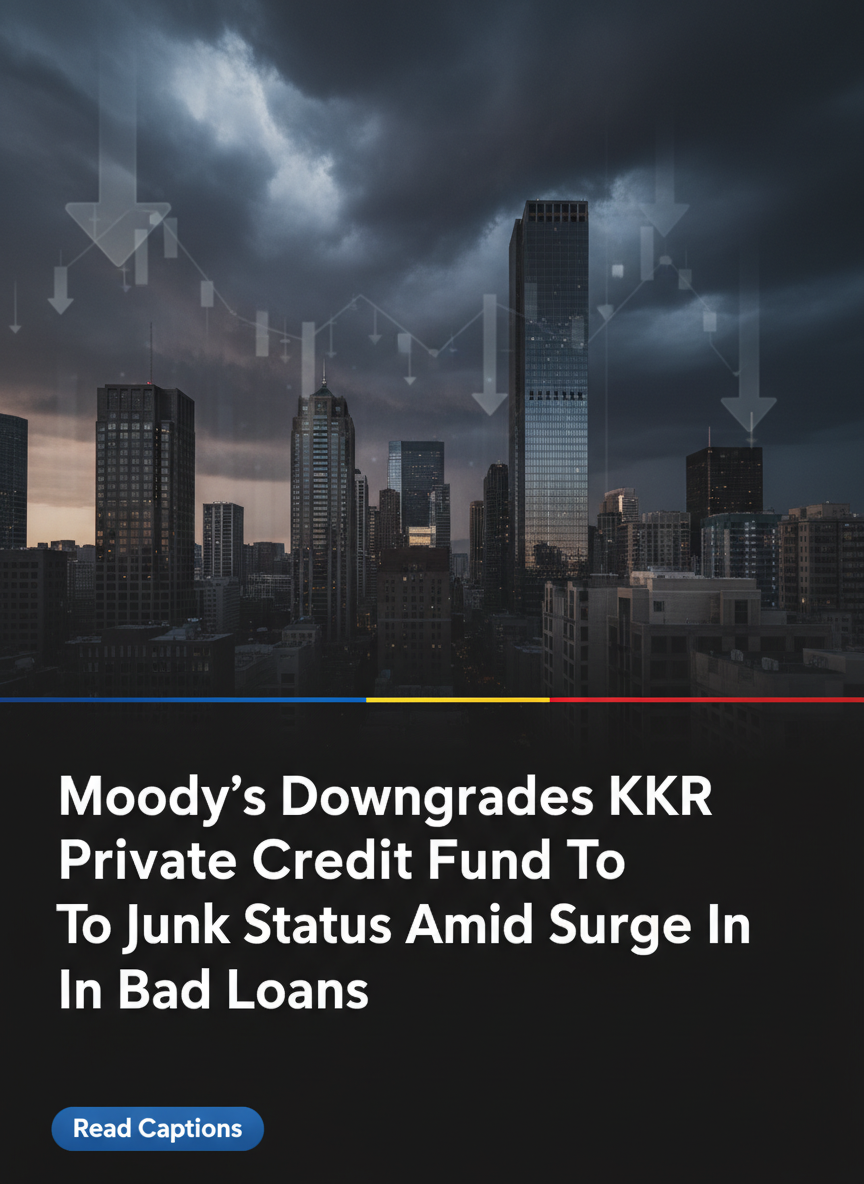
Cracks in the Private Credit Fortress: Moody’s Slashes KKR-Future Standard Fund to Junk Status
NEW YORK — In a move that has sent ripples through the alternative investment landscape, Moody’s Investors Service has officially downgraded the credit rating of a prominent private credit fund managed by KKR and Future Standard to “junk” status. The downgrade serves as a stark warning sign for the $1.7 trillion private credit market, which is currently grappling with a surge in non-performing loans and a cooling of investor enthusiasm.
A Symbolic Blow to the “Shadow Banking” Giants
The fund, a joint venture between private equity powerhouse KKR and the emerging credit specialist Future Standard, saw its rating slashed Tuesday as Moody’s cited a significant deterioration in the quality of its underlying loan portfolio. According to the ratings agency, “bad loans”—those where borrowers are struggling to meet interest or principal payments—have grown at an accelerating pace over the last two quarters.
By moving the fund into speculative-grade territory, commonly known as “junk,” Moody’s has signaled that the risk of default is no longer a peripheral concern but a central reality for investors. This transition often forces institutional investors, such as pension funds and insurance companies, to divest their holdings due to strict mandates against holding sub-investment-grade assets.
The Retail Exodus: From Blackstone to Apollo
The downgrade of the KKR-Future Standard vehicle is not an isolated incident but rather the latest symptom of a broader malaise affecting the private credit sector. For years, private credit was marketed as a high-yield, stable alternative to volatile public markets, attracting billions from wealthy retail investors.
However, that trend is reversing. Industry leaders including Blackstone and Apollo Global Management have reported a surge in redemption requests. Retail investors, spooked by the prospect of prolonged high interest rates and the resulting pressure on corporate borrowers, are rushing to withdraw their capital. In some instances, these funds have had to exercise “gates”—contractual limits on how much money can be withdrawn at once—to preserve liquidity and prevent a fire sale of assets.
Why the Tide is Turning
The current distress is largely a byproduct of the very environment that fueled private credit’s rise. Most private credit loans are “floating rate,” meaning interest payments increase alongside Federal Reserve hikes. While this initially provided a windfall for lenders, the cumulative weight of these payments has pushed many mid-sized corporate borrowers to the brink of insolvency.
“We are seeing the lag effect of monetary policy finally hitting the private markets,” said one senior analyst following the downgrade. “When the cost of debt doubles in two years, the weakest links in the chain inevitably snap. The KKR-Future Standard downgrade is simply the most visible crack in the wall.”
KKR and Future Standard Respond
In a joint statement, KKR and Future Standard defended the long-term viability of the fund, noting that they have a “proactive management strategy” in place to work with distressed borrowers. “While the current macroeconomic environment presents challenges, we believe the fundamental value of our diversified portfolio remains intact,” the statement read. The firms emphasized that they are focusing on restructuring existing debts to mitigate further losses.
A Turning Point for the Industry
For years, regulators have warned about the lack of transparency in the “shadow banking” sector, noting that because these loans are not traded on public exchanges, their true value can be obscured. This Moody’s downgrade forces a level of price discovery and risk assessment that the industry has largely avoided during its decade-long expansion.
As the market digests the news, the focus will likely shift to whether other major funds will face similar downgrades. For now, the “junk” label on a KKR-backed product serves as a sobering reminder that even the most sophisticated titans of Wall Street are not immune to the gravity of a shifting credit cycle.
Reporting by Financial News Network. All rights reserved.