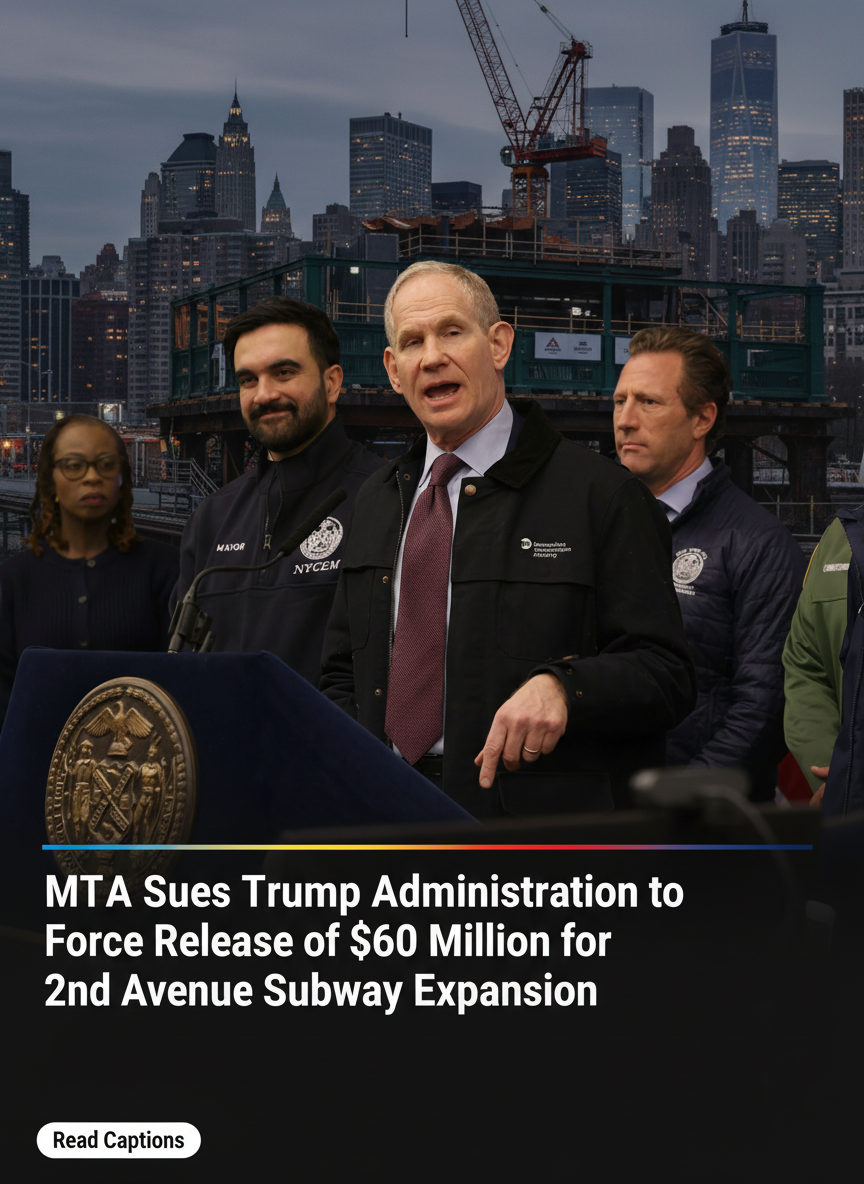
Transit Showdown: MTA Sues Trump Administration to Release Frozen $60M for Second Avenue Subway
NEW YORK — The Metropolitan Transportation Authority (MTA) filed a high-stakes federal lawsuit against the Trump administration on Tuesday, seeking to compel the release of $60 million in federal funding earmarked for the expansion of the Second Avenue Subway. The legal action marks a significant escalation in the growing tension between New York transit officials and the White House over infrastructure spending.
A “Project at Risk”
The lawsuit, filed in the U.S. District Court for the Southern District of New York, alleges that the administration’s decision to freeze the funds is a violation of federal law and existing budget appropriations. New York Governor Kathy Hochul, a staunch supporter of the transit expansion, issued a blistering statement following the filing.
“Donald Trump’s unlawful funding pause has put this entire project at risk,” Governor Hochul said. “This isn’t just about a $60 million installment; it is about the reliability of the federal government as a partner in building the infrastructure New Yorkers depend on. We will not allow political games to derail the future of East Harlem.”
The Second Avenue Extension
The dispute centers on Phase 2 of the Second Avenue Subway project, which aims to extend the Q line from 96th Street to 125th Street in East Harlem. The extension is designed to provide critical transit access to a historically underserved neighborhood, with three new stations planned at 106th, 116th, and 125th Streets.
While the $60 million currently in dispute represents only a fraction of the multi-billion dollar total cost of the project, MTA officials argue that the freeze creates a “casework of delays.” According to the complaint, the lack of immediate funds could trigger contract penalties, inflate labor costs, and potentially jeopardize billions in future federal matching grants.
A Pattern of Friction
The funding freeze is part of a broader “pause” initiated by the Trump administration to review federal spending across various agencies. White House representatives have previously suggested that the administration is looking to cut “wasteful” spending and prioritize projects that align with their specific economic goals. However, the MTA argues that once Congress has appropriated funds and the Department of Transportation has approved a project, the executive branch lacks the authority to unilaterally withhold the cash.
MTA Chair and CEO Janno Lieber emphasized that the project has already undergone rigorous federal scrutiny. “The Second Avenue Subway has met every metric, every environmental standard, and every fiscal requirement,” Lieber said. “To stop the flow of funds now is not ‘efficiency’—it’s an obstruction of progress.”
What’s Next?
Legal experts suggest the case could serve as a bellwether for how the administration handles other “frozen” infrastructure projects across the country. If the MTA prevails, it could embolden other states and municipalities to challenge federal funding pauses in court.
For now, the Second Avenue Subway extension remains in a state of uncertainty. While preliminary work continues, the MTA warned that without the release of the $60 million, major construction milestones could be missed before the end of the fiscal year. As the legal battle moves forward, millions of commuters and East Harlem residents are left waiting to see if the long-promised “subway to uptown” will remain on track or become another victim of political gridlock.
Reporting by City Desk News. Published March 17, 2026.