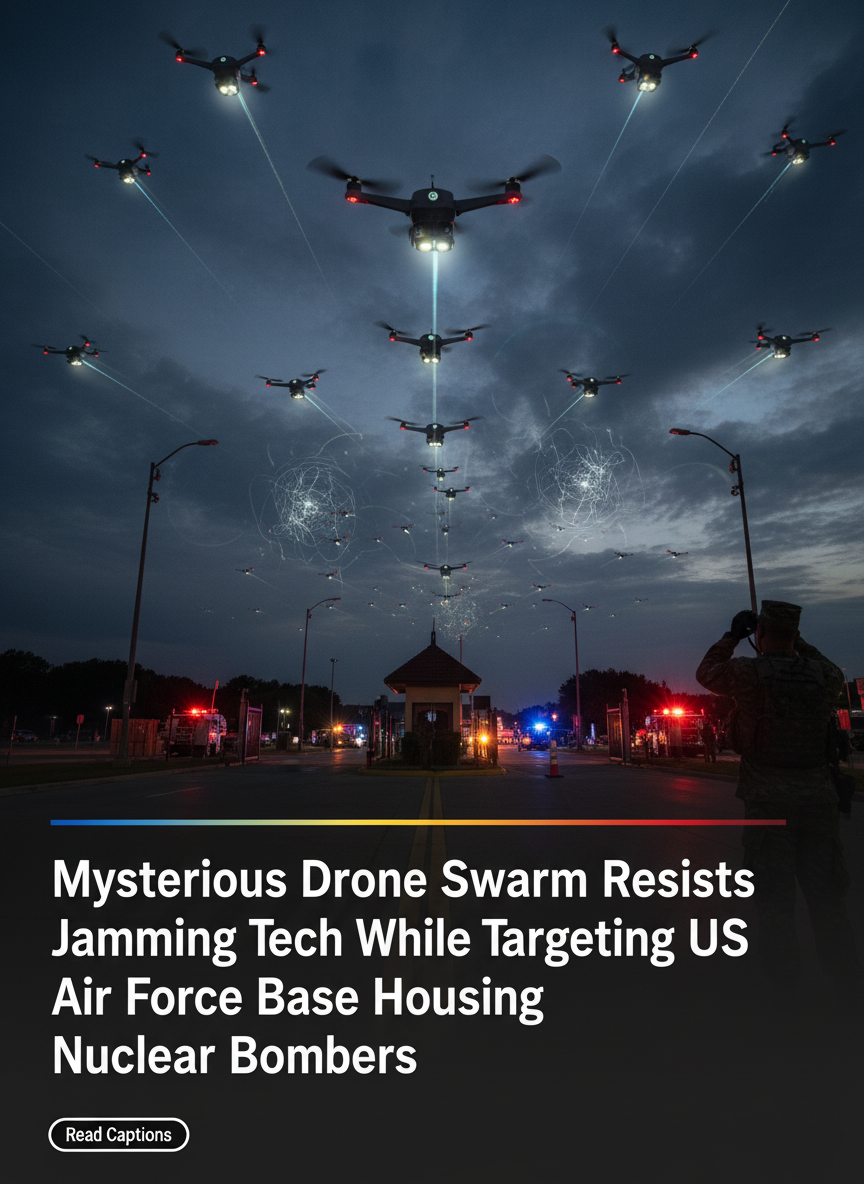
Security Breach: Mysterious Drone Swarms Infiltrate US Air Force Base Housing Nuclear Bombers
BARKSDALE AIR FORCE BASE — In a series of incidents that have sent shockwaves through the Department of Defense, more than a dozen unidentified drones have repeatedly swarmed a sensitive U.S. Air Force base home to the nation’s strategic nuclear bomber fleet. Military officials confirmed this week that the unsanctioned aircraft demonstrated a level of technological sophistication that allowed them to bypass standard electronic defense measures.
An Unprecedented Incursion
The incursions, which occurred over several nights, involved a coordinated “swarm” of at least 12 to 15 drones. The craft were observed hovering over restricted areas and flight lines where nuclear-capable aircraft are stationed. While the military has protocols for dealing with unauthorized Unmanned Aerial Systems (UAS), the persistence and scale of this event have raised serious questions about the vulnerability of the nation’s most critical hardware.
According to sources familiar with the incidents, the drones were not merely hobbyist toys. They appeared to be operating with a degree of coordination and intent that suggests a highly organized effort, though the origin of the operators remains unknown.
Defying Electronic Warfare
Perhaps the most alarming aspect of the breach was the failure of traditional “soft-kill” countermeasures. Security personnel reportedly deployed jamming technology intended to sever the link between the drones and their operators, or to disrupt their GPS navigation. However, the drones proved remarkably resilient.
“These were not your off-the-shelf consumer drones,” one official stated, speaking on the condition of anonymity. “They were able to resist jamming efforts that typically bring down commercial units instantly. This suggests a level of encryption or autonomous flight programming that is deeply concerning to our technical teams.”
National Security Implications
The base in question serves as a cornerstone of the U.S. nuclear triad, housing a significant portion of the country’s long-range bomber force. The ability of unidentified entities to surveil—and potentially threaten—these assets is being treated as a major security failure. The Air Force has since heightened its alert status, but the elusive nature of the drones has made it difficult to identify the perpetrators.
National security experts are weighing two primary possibilities: that the drones are being operated by a foreign adversary seeking intelligence on U.S. nuclear readiness, or that they are part of a sophisticated domestic operation testing military responses. Regardless of the source, the inability to ground the craft has exposed a significant gap in domestic base defense.
The Investigation Continues
The Pentagon, in coordination with the FBI and the FAA, has launched a comprehensive investigation into the sightings. Investigators are currently analyzing sensor data and visual accounts to determine the drones’ launch points and flight paths. For now, the “ghost fleet” remains a mystery, leaving one of the world’s most powerful military installations searching for answers.
As of Saturday, no group has claimed responsibility for the flights, and the Air Force has declined to specify what further “hard-kill” measures might be authorized if the swarms return. The incident serves as a stark reminder that as drone technology evolves, the barriers protecting the nation’s most sensitive secrets are facing a new and agile breed of threat.