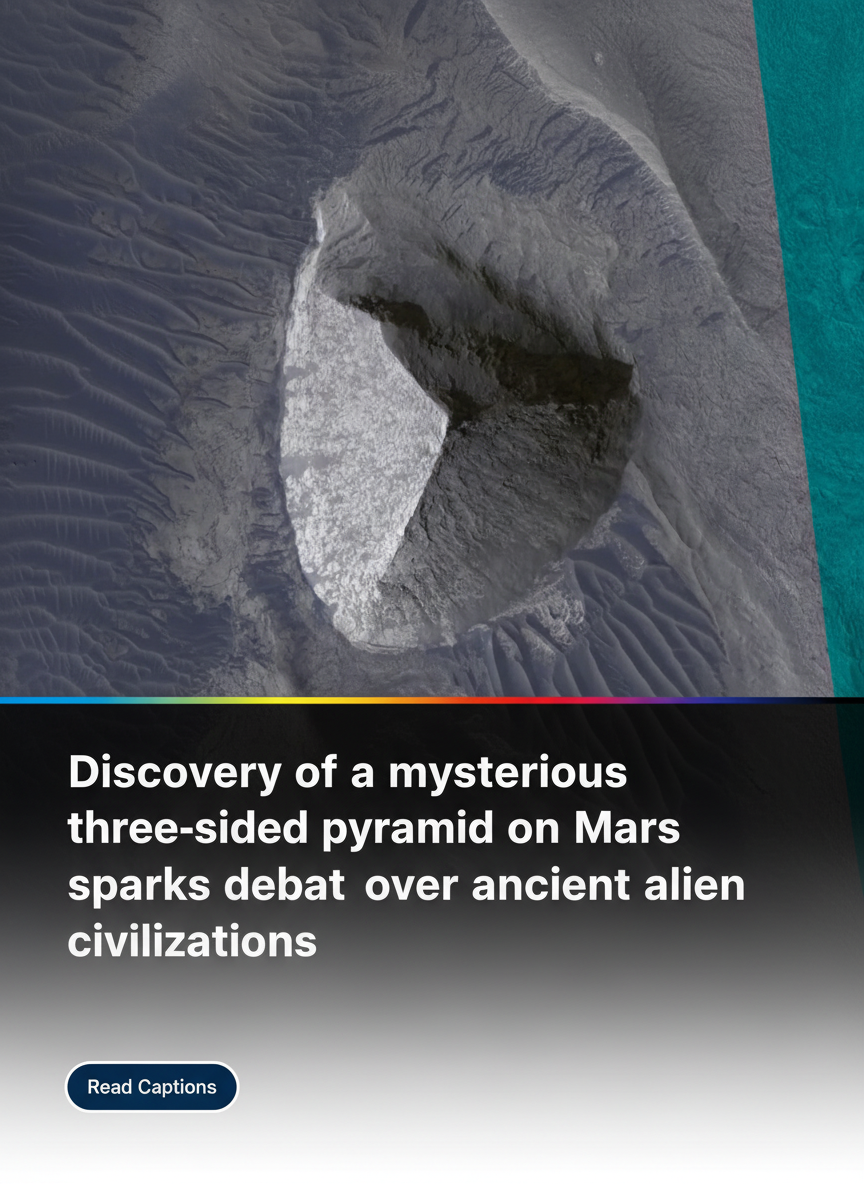
Red Planet Enigma: Mysterious ‘Three-Sided’ Pyramid on Mars Fuels Speculation About Advanced Alien Civilizations
MARS — In a discovery that has sent shockwaves through the scientific community and ignited a firestorm of internet theories, high-resolution imagery from the latest Mars reconnaissance mission has revealed a startlingly geometric structure: a massive, three-sided pyramid rising from the dusty plains of the Red Planet.
The structure, located in the rugged terrain of the Terra Meridiani region, appears to be a near-perfect tetrahedron. Unlike the eroded mounds commonly found on Mars, this “pyramid” features sharp edges and distinct faces that catch the sunlight in a way that many observers claim looks decidedly artificial. The discovery has reignited the age-old debate: are we looking at a geological fluke, or the architectural remains of a long-lost Martian civilization?
Three Sides to Every Story
As the headline suggests, the discourse surrounding the discovery has split into three distinct camps, each offering a different perspective on the Martian anomaly.
The first “side” belongs to the proponents of the extraterrestrial hypothesis. Independent researchers and amateur astronomers point to the mathematical precision of the structure. “Nature rarely works in straight lines and perfect triangles on this scale,” said Dr. Elena Vance, a former consultant for the SETI Institute. “When you see a three-sided structure with this kind of symmetry, you have to ask if it was designed with intent. This could be a marker, a tomb, or even a piece of ancient technology.”
The second side is represented by NASA and the mainstream scientific community, who urge extreme caution. Geologists argue that “wind-sculpted” formations, known as yardangs, can often take on sharp, geometric shapes over millions of years of Martian dust storms. “Mars is a master of pareidolia—the human tendency to see familiar patterns in random shapes,” explained NASA spokesperson Dr. Marcus Thorne. “We’ve seen ‘faces,’ ‘spoons,’ and ‘doors’ before, and every time, higher-resolution data reveals them to be natural rock formations. We expect this pyramid to be no different.”
The third side is the public and cultural impact. On social media, the hashtag #MarsPyramid has trended globally since the images were released early Wednesday morning. For many, the discovery represents a glimmer of hope or a cosmic mystery that transcends scientific bickering. “It doesn’t matter if it’s a rock or a building,” one viral post read. “It reminds us that we are still looking at the stars and asking the big questions.”
Closer Inspection Needed
The structure stands approximately 150 meters tall, roughly the size of the Great Pyramid of Giza. However, its three-sided nature is what makes it unique compared to previous “pyramid” sightings in the Cydonia region, which were often more mound-like or four-sided.
Orbital analysis suggests the pyramid is composed of a denser basaltic rock than the surrounding plains, which may explain why it has resisted erosion more effectively than its neighbors. Plans are already being drafted to re-task the Perseverance II rover to perform a long-distance flyby or deploy a scouting drone to capture 3D mapping data of the site.
Conclusion: The Mystery Remains
Until a rover can physically scrape the surface of the Terra Meridiani pyramid, the “three sides” of the story will continue to clash. Whether it is a monumental achievement of an alien past or a stunning masterwork of Martian wind and time, the mystery has successfully captured the world’s imagination.
As one researcher put it: “Mars continues to be the ultimate mirror. We look at it and see exactly what we’re looking for—whether that’s physics or phantoms.”