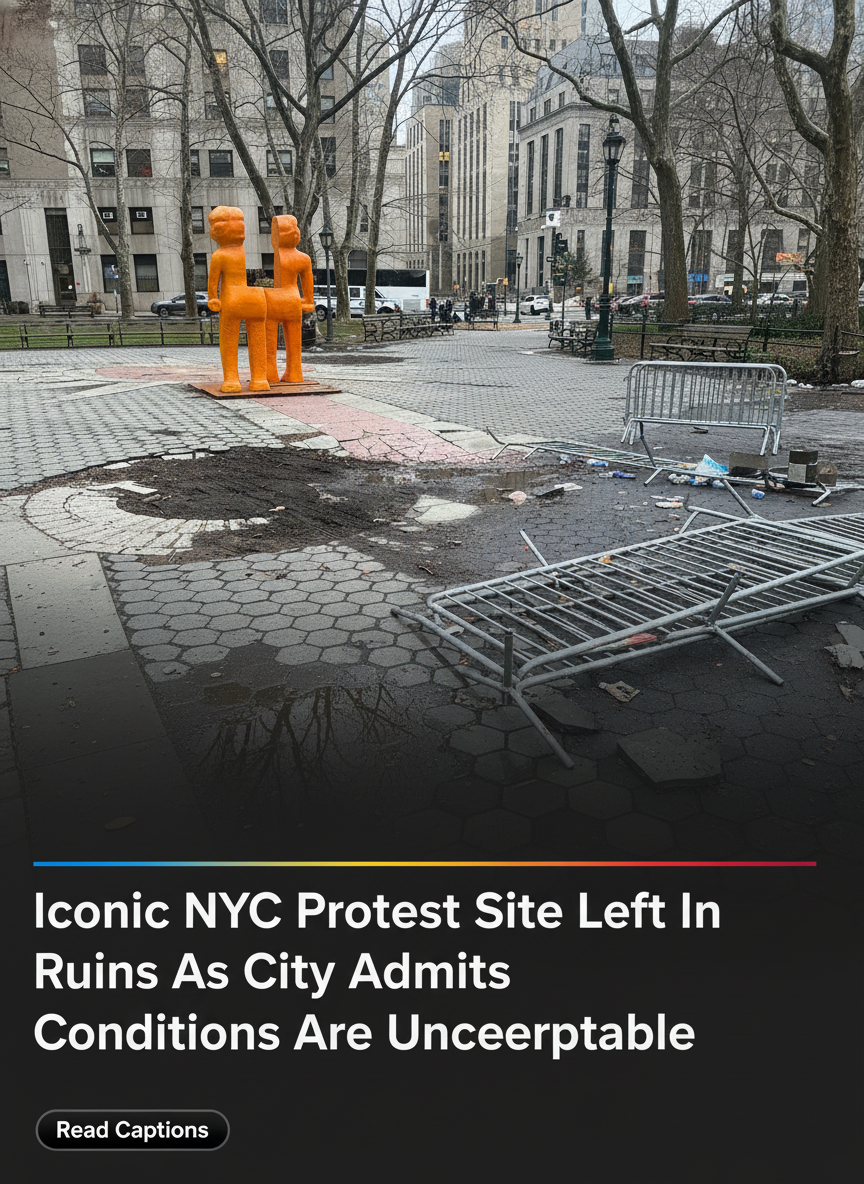
Crumbling History: Iconic NYC Protest Hub Left to Rot as Mamdani Administration Admits ‘Unacceptable’ Decay
By City Desk | March 22, 2026
It has served as the stage for the city’s most pivotal moments of civil unrest, from the height of the Occupy Wall Street movement to the impassioned anti-ICE demonstrations of years past. But today, one of New York City’s most historic plazas stands as a grim monument to municipal neglect, characterized by shattered pavement, flickering lights, and a mounting sense of abandonment.
The city-maintained green space, a landmark that has historically funneled the energy of New York’s political life, has officially fallen into “abysmal” disrepair. According to a scathing internal audit conducted late last year, the site received a rare “unacceptable” rating—the lowest possible grade for public infrastructure. Despite the warning, officials within the Mamdani administration admitted this week that the site remains in unsightly and hazardous condition months later.
A ‘Minefield’ for Pedestrians
For those traversing the plaza today, the experience is less about civic engagement and more about survival. Large sections of the historic bluestone and concrete pavement have been reduced to rubble, creating significant tripping hazards for tourists and office workers alike. At night, the situation grows more dire; a series of defective lamp posts has left vast swaths of the park in total darkness, raising immediate safety concerns.
“It’s a minefield,” said Marcus Thorne, a local resident who passes through the plaza daily. “You’ve got wires exposed, jagged edges of stone sticking up, and half the lights are out. This used to be a place where people gathered to speak truth to power. Now, you’re just trying not to break an ankle.”
The Audit the City Ignored
The decline of the plaza isn’t just a matter of perception—it’s a matter of record. The 2025 city audit highlighted specific structural failures, including drainage issues that lead to massive pooling during rainstorms and a complete breakdown of the ornamental lighting fixtures. The “unacceptable” rating was intended to trigger immediate emergency repairs.
However, the Mamdani administration has struggled to explain why the site remains a shambles. In a recent press briefing, administration officials conceded that the plaza is in “unsightly condition,” yet pointed to “budgetary bottlenecks” and “contractor delays” as the primary reasons for the lack of progress.
A Symbol of Bureaucratic Gridlock
Critics argue that the neglect of such a high-profile space is symbolic of a larger failure to maintain the city’s “living rooms.” Because the plaza has been the epicenter of radical protest, some activists have even questioned if the delay is a subtle form of “benign neglect” to discourage future mass gatherings.
“This is one of the most photographed and utilized spaces in Lower Manhattan,” said urban historian Elena Rodriguez. “To let it fall into this state of decay—knowing full well it failed an audit—suggests a total breakdown in the Parks and Transportation departments. It’s an embarrassment to the city’s heritage.”
The Road Ahead
As the spring tourism season approaches, the pressure is mounting on City Hall to move beyond admissions of failure and toward actual restoration. While a spokesperson for the Mayor’s office stated that a “comprehensive rehabilitation plan” is in the works, no timeline has been provided for when the first stone will be replaced or the first lightbulb changed.
Until then, the historic plaza remains a crumbling shadow of its former self—a literal “unacceptable” blemish on the face of the New York City landscape.