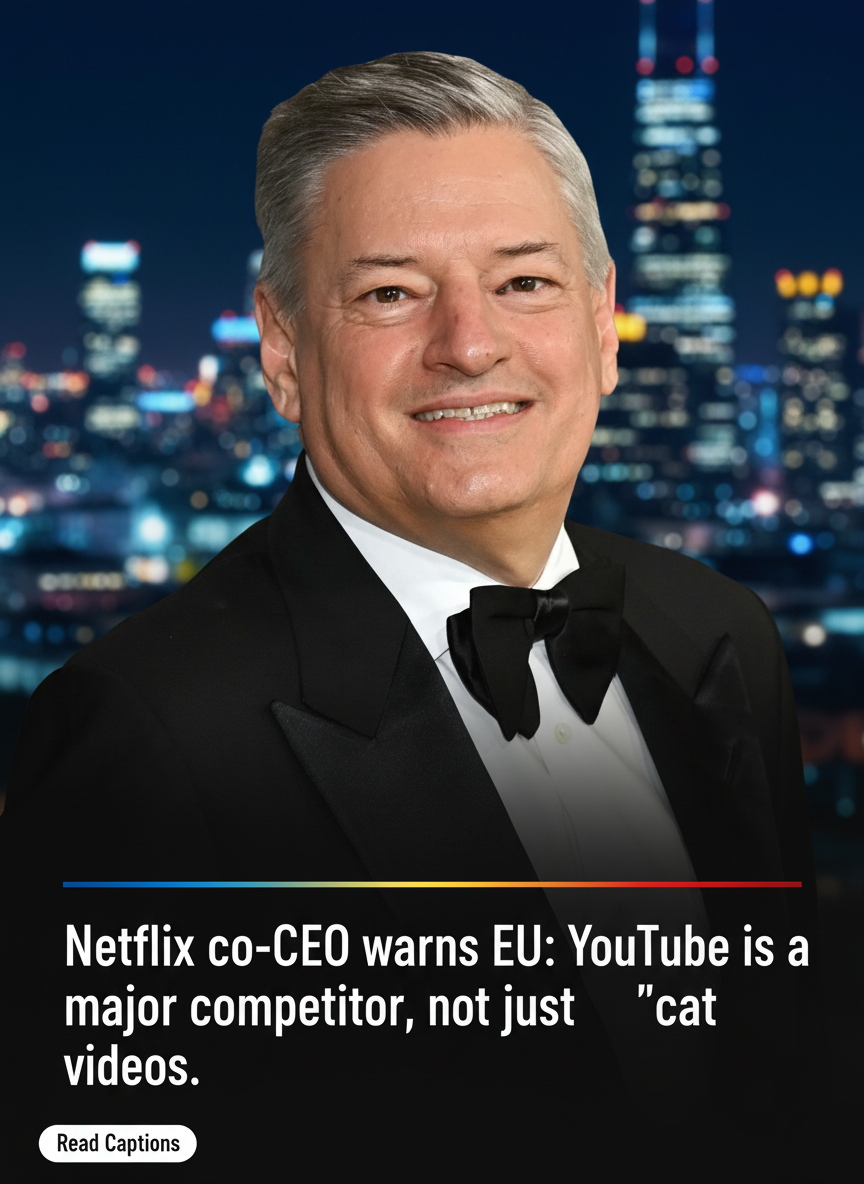
Netflix’s Ted Sarandos Challenges EU Regulators: YouTube is a ‘Straightforward Direct Competitor,’ Not Just ‘Cat Videos’
BRUSSELS — In a strategic move to reshape the European media landscape, Netflix co-CEO Ted Sarandos has issued a stern warning to European Union regulators: stop treating YouTube as a social media side-project and start recognizing it as the dominant force in entertainment it has become.
Arriving in Brussels ahead of a pivotal review of the bloc’s streaming and broadcasting regulations, Sarandos used an interview with Politico to dismantle the perception that YouTube is merely a repository for amateur clips. He argued that the Google-owned platform now represents a “straightforward direct competitor” that continues to evade the stringent regulatory burdens placed on traditional streamers and broadcasters.
Beyond the ‘Cat Video’ Stereotype
For years, regulators have distinguished between “curated” platforms like Netflix or Disney+ and “user-generated” platforms like YouTube and TikTok. However, Sarandos argues that this distinction is increasingly obsolete. In his view, the battle for the “living room screen” is one where YouTube is often winning, yet playing by a different set of rules.
“It’s not just a bunch of cat videos,” Sarandos told Politico. “It is a massive, professionalized ecosystem of content that competes for the exact same hour of the day that a person might spend watching Stranger Things or the evening news.”
Sarandos pointed to the shifting habits of consumers, noting that YouTube now accounts for a significant portion of television screen time globally—frequently surpassing major streaming services in monthly viewership totals, according to data from firms like Nielsen. By dismissing YouTube as a social network rather than a media giant, Sarandos contends that regulators are ignoring the elephant in the room.
The Regulatory Tug-of-War
The timing of Sarandos’s comments is no coincidence. The European Commission is currently preparing a review of the Audiovisual Media Services Directive (AVMSD). This framework currently imposes strict requirements on streamers, including a mandate that at least 30% of their catalogs consist of European works and requirements to invest directly in local film and television production.
Netflix has long argued that while it contributes billions to the European creative economy, YouTube operates with far more leniency regarding content quotas and financial obligations to local industries. Sarandos suggested that if the EU’s goal is to protect the European “cultural ecosystem,” it must apply its rules equitably across all platforms that command significant audience attention.
“If you’re going to regulate the impact of media on culture, you have to look at where the culture is actually being consumed,” Sarandos argued. “Right now, there is a massive regulatory gap that favors big tech over creative studios.”
A Warning for Broadcasters
While Sarandos was in Brussels representing Netflix, his message carried an olive branch of sorts to traditional European broadcasters. He noted that the “existential threat” to local television stations isn’t just global streamers like Netflix, but the unregulated flow of content on platforms like YouTube that siphons away both viewers and advertising revenue.
Industry analysts suggest that Sarandos’s rhetoric marks a shift in Netflix’s lobbying strategy. Rather than simply fighting against more regulation, the streaming giant is now pushing for a “level playing field” that would force its biggest rivals to shoulder the same cultural and financial responsibilities.
The Road Ahead
As EU policymakers begin the arduous process of updating the AVMSD, Sarandos’s comments are expected to spark a heated debate among tech giants in Silicon Valley and lawmakers in Brussels. With YouTube’s influence over younger demographics reaching unprecedented levels, the question of what constitutes a “broadcaster” in the digital age has never been more contentious.
For Netflix, the goal is clear: ensure that the rules of the game reflect the reality of the 2026 media market. Whether Brussels is ready to reclassify the world’s largest video site as a direct peer to Hollywood remains to be seen.