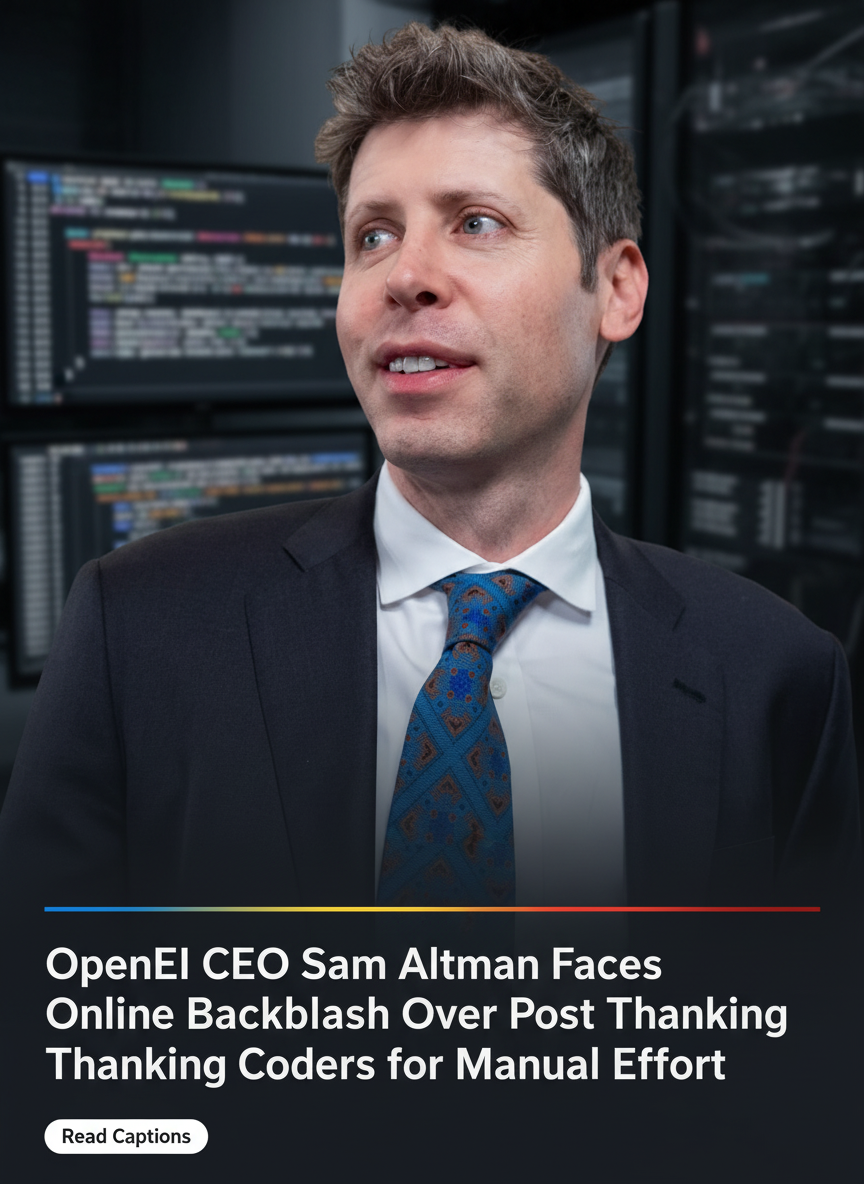
‘This is Tone Deaf’: OpenAI CEO Sam Altman Roasted for Tweet ‘Thanking’ Software Coders
SAN FRANCISCO — Sam Altman, the CEO of OpenAI and a leading figure in the artificial intelligence revolution, found himself at the center of a social media firestorm this week. What was intended as a note of gratitude toward software developers quickly soured, as critics labeled the billionaire’s comments “tone-deaf” and “condescending” in an era where AI is rapidly encroaching on traditional tech jobs.
The Tweet That Sparked the Fire
On Tuesday, Altman took to X (formerly Twitter) to reflect on the evolution of software engineering. “I have so much gratitude to people who wrote extremely complex software character-by-character,” Altman wrote. “It already feels difficult to remember how much effort it really took.”
The post, which has since garnered millions of views, was meant to highlight the efficiency gains brought about by Large Language Models (LLMs) like ChatGPT and GitHub Copilot. However, the tech community—many of whom feel their livelihoods are being threatened by the very tools Altman’s company creates—did not take the sentiment well.
A “Funeral Oration” for the Coding Profession
The backlash was swift and sharp. Many developers took issue with Altman’s use of the past tense, arguing that he spoke about manual coding as if it were an ancient, extinct craft rather than a modern, living profession.
“This reads like a funeral oration for a profession you are actively trying to kill,” wrote one X user in a reply that received thousands of likes. Others pointed out the irony of a billionaire thanking workers for their “effort” while simultaneously marketing products designed to automate their roles.
Critics argued that “character-by-character” coding isn’t just about labor; it is about logic, architecture, and human ingenuity—elements they fear are being oversimplified by the narrative of AI efficiency. “It’s not just about the characters; it’s about the thinking,” another developer remarked. “You’re not thanking us; you’re patronizing us.”
The Growing Tension in Silicon Valley
The friction following Altman’s tweet underscores a deeper anxiety within the tech industry. As OpenAI continues to refine its models, the capability of AI to write, debug, and optimize code has grown exponentially. For companies, this means lower costs and faster deployment. For software engineers, it has led to a shifting job market and fears of obsolescence.
This is not the first time Altman has faced criticism for his public statements. As the face of the AI boom, his comments are often scrutinized for how they address the societal shifts caused by automation. While Altman has frequently called for regulation and a Universal Basic Income to offset job losses, his critics argue that his public persona often leans too heavily into “tech-messianism.”
Efficiency vs. Craftsmanship
Despite the backlash, some in the AI community defended Altman, suggesting his comments were a genuine acknowledgement of the sheer scale of human achievement that preceded the AI era. These supporters argue that AI is a tool that elevates developers, allowing them to focus on high-level problem solving rather than the “toil” of syntax.
However, for the many coders currently navigating a landscape of tech layoffs and hiring freezes, the “gratitude” of a CEO whose company is valued at over $80 billion felt less like a thank-you and more like a victory lap.
Conclusion
The controversy serves as a stark reminder of the cultural divide currently splitting Silicon Valley. As OpenAI moves forward with increasingly powerful versions of GPT, the tension between the pioneers of AI and the human workers who built the foundations of the digital world is likely to intensify. For Sam Altman, a simple tweet served as a lesson in how quickly “gratitude” can be interpreted as “insult” when the future of work is at stake.