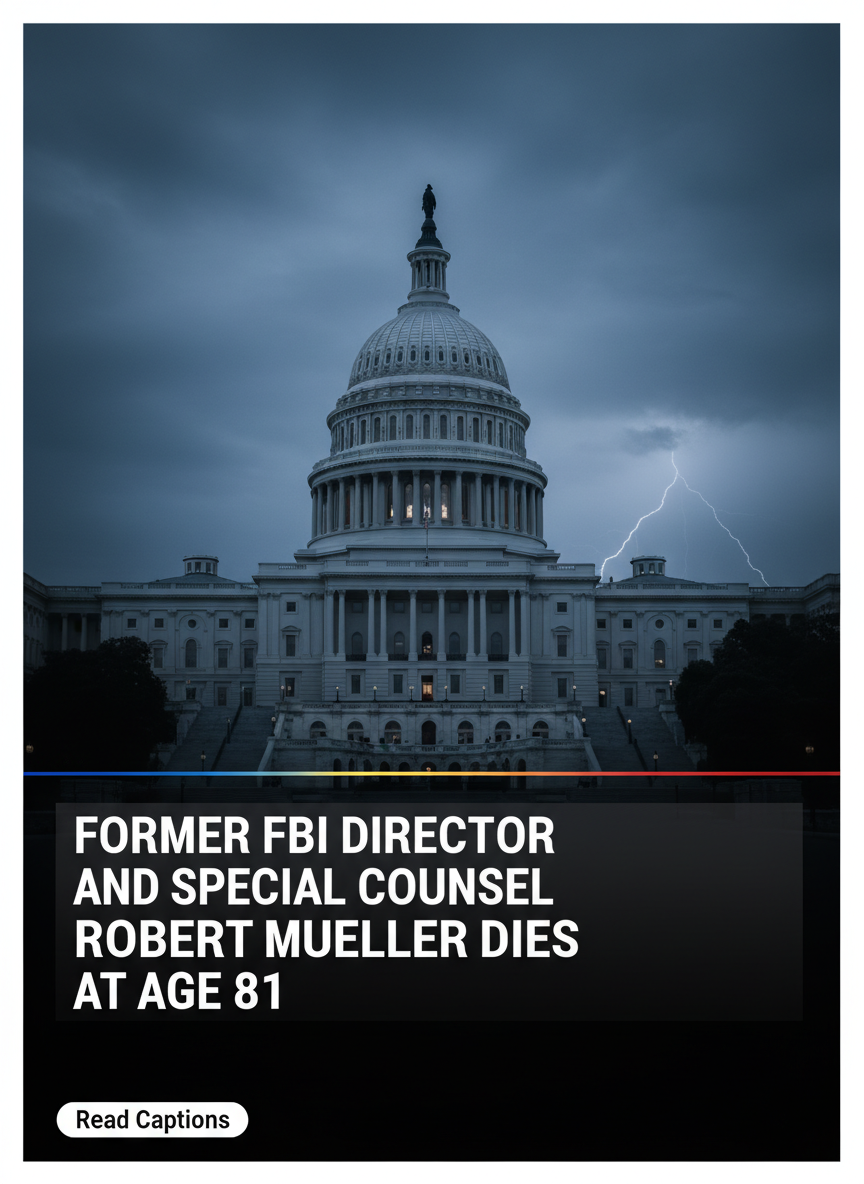
Robert Mueller, Longtime FBI Director and Special Counsel, Dies at 81
WASHINGTON — Robert S. Mueller III, the stoic former FBI director who steered the bureau through the aftermath of the Sept. 11 attacks and later returned to public service as the special counsel investigating Russian interference in the 2016 election, has died at the age of 81.
Mueller’s death marks the end of a storied career in American law enforcement and public service that spanned five decades. Known for his “straight-arrow” reputation and a relentless commitment to institutional integrity, Mueller became one of the most consequential figures in modern American history, serving under both Republican and Democratic administrations.
A Career Defined by Crisis
Mueller took the helm of the FBI on Sept. 4, 2001, just one week before the terrorist attacks on the World Trade Center and the Pentagon. The events of 9/11 fundamentally altered his mandate, forcing him to transform the FBI from a traditional domestic law enforcement agency into a global intelligence-led organization focused on counterterrorism.
His leadership during those turbulent years earned him rare bipartisan respect. In 2011, as his ten-year term was set to expire, President Barack Obama asked him to stay on for an additional two years, a request that required special legislation from Congress. He ultimately served 12 years, making him the longest-serving FBI director since J. Edgar Hoover.
The Special Counsel Investigation
Though Mueller had settled into a quiet retirement in 2013, he was pulled back into the national spotlight in May 2017. Following the firing of FBI Director James Comey, the Justice Department appointed Mueller as special counsel to oversee the federal investigation into Russian efforts to influence the 2016 presidential election and any potential coordination with Donald Trump’s campaign.
For two years, the “Mueller Probe” dominated the American political landscape. Characteristically tight-lipped, Mueller never spoke to the media during the investigation, communicating only through dozens of criminal indictments of Russian nationals and key Trump campaign associates.
The final “Mueller Report,” released in 2019, concluded that while Russia had interfered in the election in a “sweeping and systematic fashion,” the evidence did not establish a criminal conspiracy between the Trump campaign and the Kremlin. On the question of whether President Trump had obstructed justice, Mueller famously declined to reach a binary conclusion, stating, “While this report does not conclude that the President committed a crime, it also does not exonerate him.”
A Legacy of Service and Sacrifice
Before his time in the halls of power in Washington, Mueller was a decorated war veteran. A graduate of Princeton University, he joined the United States Marine Corps during the Vietnam War. He led a rifle platoon and earned a Bronze Star, two Navy Commendation Medals, and a Purple Heart after being wounded in combat.
Colleagues and adversaries alike often referred to him as “Bobby Three Sticks”—a nod to his full name, Robert Swan Mueller III—and described him as a man of few words and immense discipline. He was seen as a vestige of an older, more formal era of Washington, one where institutional loyalty and the rule of law were held above partisan politics.
Conclusion
Robert Mueller’s passing has prompted a wave of tributes from across the political spectrum. Supporters remember him as a selfless patriot who stepped up when his country called, while his role in the Russia investigation ensures he will remain a central, if debated, figure in American political history.
He is survived by his wife, Ann, and their two daughters. Funeral arrangements have not yet been announced, but it is expected that dignitaries from several decades of American government will gather to honor the man who spent his life guarding the nation’s most critical institutions.