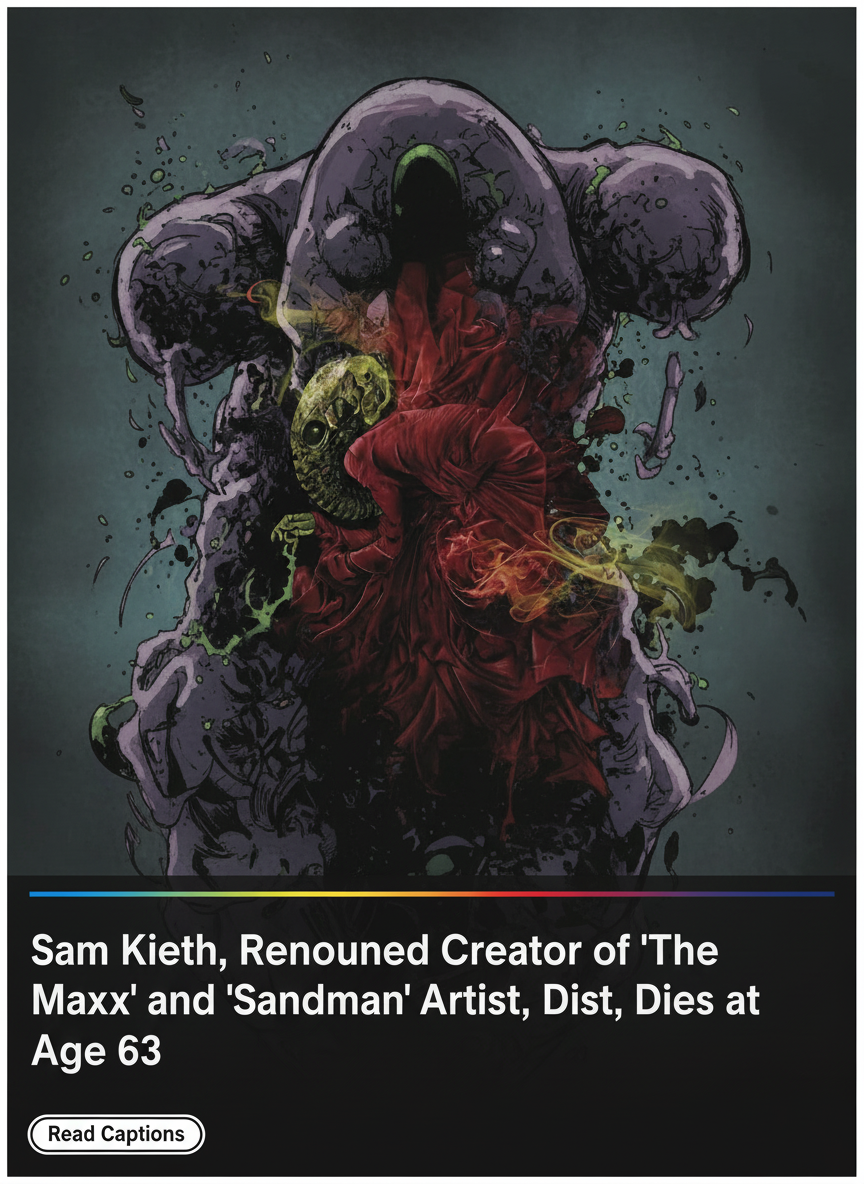
Sam Kieth, Visionary Creator of ‘The Maxx’ and ‘Sandman’ Artist, Dies at 63
The comic book industry mourns the loss of a singular talent whose surreal, psychological style redefined the visual language of the medium.
Sam Kieth, the influential comic book artist and writer best known for creating the cult-classic series The Maxx and his foundational work on Neil Gaiman’s The Sandman, died on March 15. He was 63 years old.
His passing was confirmed by his lifelong friend and longtime collaborator, Scott Dunbier, who told Bleeding Cool that Kieth died following a battle with Lewy Body Dementia. Kieth’s death marks the end of a career spanning over four decades, during which he became one of the most recognizable and idiosyncratic voices in the history of graphic storytelling.
A Prodigy in the World of Panels
Born on January 11, 1963, Kieth’s entry into the professional world was as precocious as his art was complex. He began publishing in comics at the age of 17, quickly gaining attention for a style that eschewed the traditional, clean-cut anatomy of 1980s superheroes in favor of something more visceral, distorted, and emotionally raw.
In 1989, Kieth played a pivotal role in the birth of a literary phenomenon when he illustrated the first few issues of The Sandman for DC Comics. Alongside writer Neil Gaiman and inker Mike Dringenberg, Kieth helped establish the dark, dreamlike aesthetic of Morpheus and his realm, laying the groundwork for what would become one of the most celebrated series in the medium’s history.
The Birth of ‘The Maxx’ and Image Comics
While his work on The Sandman brought him prestige, it was the 1993 launch of The Maxx at Image Comics that cemented Kieth’s status as a visionary creator. The series followed a purple-clad, hulking homeless man who shifted between the gritty reality of a modern city and a prehistoric dreamscape known as “The Outback.”
Deeply psychological and often surreal, The Maxx dealt with themes of trauma, escapism, and the human psyche in a way few comics had dared to before. The series was later adapted into a critically acclaimed animated series for MTV’s Oddities in 1995, reaching a mainstream audience and becoming a hallmark of 90s alternative culture.
A Legacy of Innovation
Beyond his independent successes, Kieth brought his unique lens to mainstream icons. His run on Wolverine: Blood Hungry remains a fan-favorite for its jagged, feral depiction of the character, and his work on Batman: Secrets and Arkham Asylum: Madness showcased his ability to find the fractured humanity within legendary caped figures.
Later in his career, Kieth continued to push boundaries with creator-owned projects like Zero Girl and Four Women, works that emphasized his interest in character-driven, unconventional narratives. His art—characterized by its mix of delicate linework, heavy shadows, and exaggerated proportions—inspired a generation of artists to prioritize atmosphere and emotion over rigid realism.
Conclusion
Sam Kieth was more than an illustrator; he was a world-builder who invited readers into the deepest corners of his imagination. Whether he was depicting the ethereal realms of the Dreaming or the rugged landscapes of the Outback, Kieth’s work was always unmistakably his own.
He is survived by a legacy of art that continues to challenge and inspire. For fans of the medium, Kieth’s contributions remain a reminder that comics are not just about heroes, but about the beautiful, messy, and surreal complexity of the human mind.