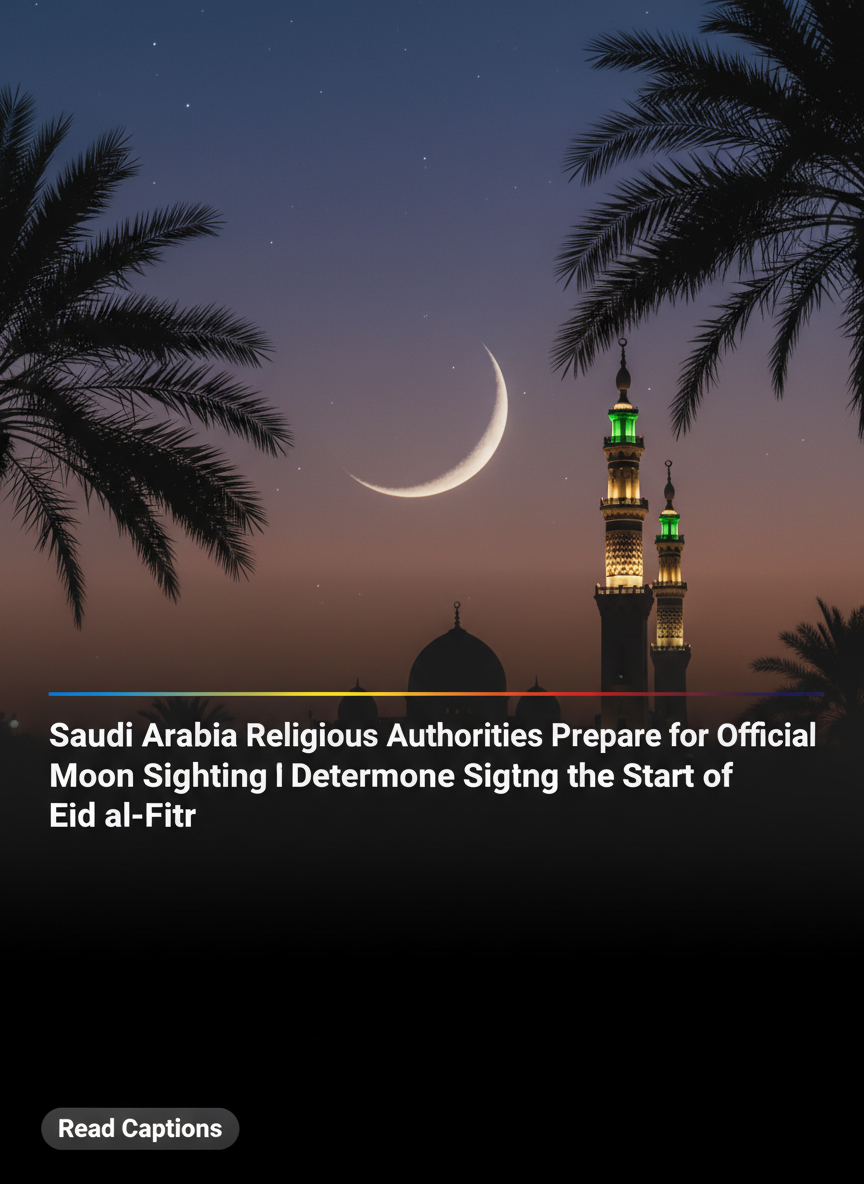
Saudi Arabia Calls for Eid al-Fitr Moon Sighting: What You Need to Know as Ramadan 2026 Nears End
RIYADH, Saudi Arabia — As the holy month of Ramadan reaches its final days, global attention has turned toward the desert horizons of the Arabian Peninsula. On March 18, 2026, “Saudi Arabia Eid moon sighting” surged as a top trending topic on Google in the United States, reflecting the anticipation of millions of Muslims preparing for the festival of Eid al-Fitr.
The Current Situation: Why It’s Trending Now
The sudden spike in search interest—recording over 2,000 searches in a four-hour window—comes as the Islamic world approaches the 29th day of Ramadan 1447 AH. In the Islamic lunar calendar, months last either 29 or 30 days, depending on the sighting of the new crescent moon (the Hilal).
The Saudi Supreme Court has officially called upon citizens and residents throughout the Kingdom to look for the crescent moon on the evening of Thursday, March 19, 2026. Because Saudi Arabia is home to Islam’s holiest sites, Mecca and Medina, its official declaration serves as a primary guide for many Muslim communities worldwide, including a significant portion of the 3.45 million Muslims living in the United States.
Key Facts and Important Details
As the moon sighting process begins, there are several critical details for observers and celebrants to keep in mind:
- The Decision Dates: If the moon is sighted on the evening of Thursday, March 19, Eid al-Fitr will officially begin on Friday, March 20. If the moon is not visible, Ramadan will complete 30 days, and Eid will be celebrated on Saturday, March 21.
- Method of Sighting: The Saudi Supreme Court encourages sightings made with the naked eye or through binoculars. Verified sightings must be reported to the nearest court to be officially registered.
- Official Observatories: While public participation is encouraged, the Kingdom relies heavily on specialized observatories in Sudair and Tumair, which utilize advanced astronomical equipment to assist traditional methods.
- The Significance of “Friday Eid”: If the moon is sighted Thursday night, Eid will fall on a Friday. In Islamic tradition, this is considered doubly blessed as Friday is already a weekly day of congregational prayer (Jumu’ah).
Background Context and History
Eid al-Fitr, the “Festival of Breaking the Fast,” marks the conclusion of a month of fasting, prayer, and reflection. Historically, the start of Islamic months has always relied on physical moon sightings, a tradition rooted in the teachings of the Prophet Muhammad.
In the modern era, the intersection of ancient tradition and modern science often leads to debate. While Saudi Arabia and several other Gulf nations typically follow the physical sighting within the Kingdom, other nations and organizations—such as the Fiqh Council of North America—often utilize astronomical calculations to pre-determine dates for better logistical planning.
The trend in U.S. search traffic highlights the logistical importance of this announcement. For Muslim Americans, the Saudi declaration often dictates when they take time off work, book prayer halls, and organize community festivals. Because the U.S. spans multiple time zones, the “official” word from Riyadh (usually released around 12:00 PM to 2:00 PM EST) allows families in New York, Chicago, and Los Angeles to finalize their preparations for the following morning.
Conclusion
As of the afternoon of March 18, the world remains in a state of “wait and see.” The outcome of the sighting on Thursday evening will determine whether the fast ends tomorrow or the day after. Regardless of the specific day, the global interest in the Saudi moon sighting underscores the enduring cultural and religious significance of the lunar cycle in the 21st century.
Stay tuned for further updates as the Saudi Supreme Court prepares to release its official verdict on the evening of March 19.