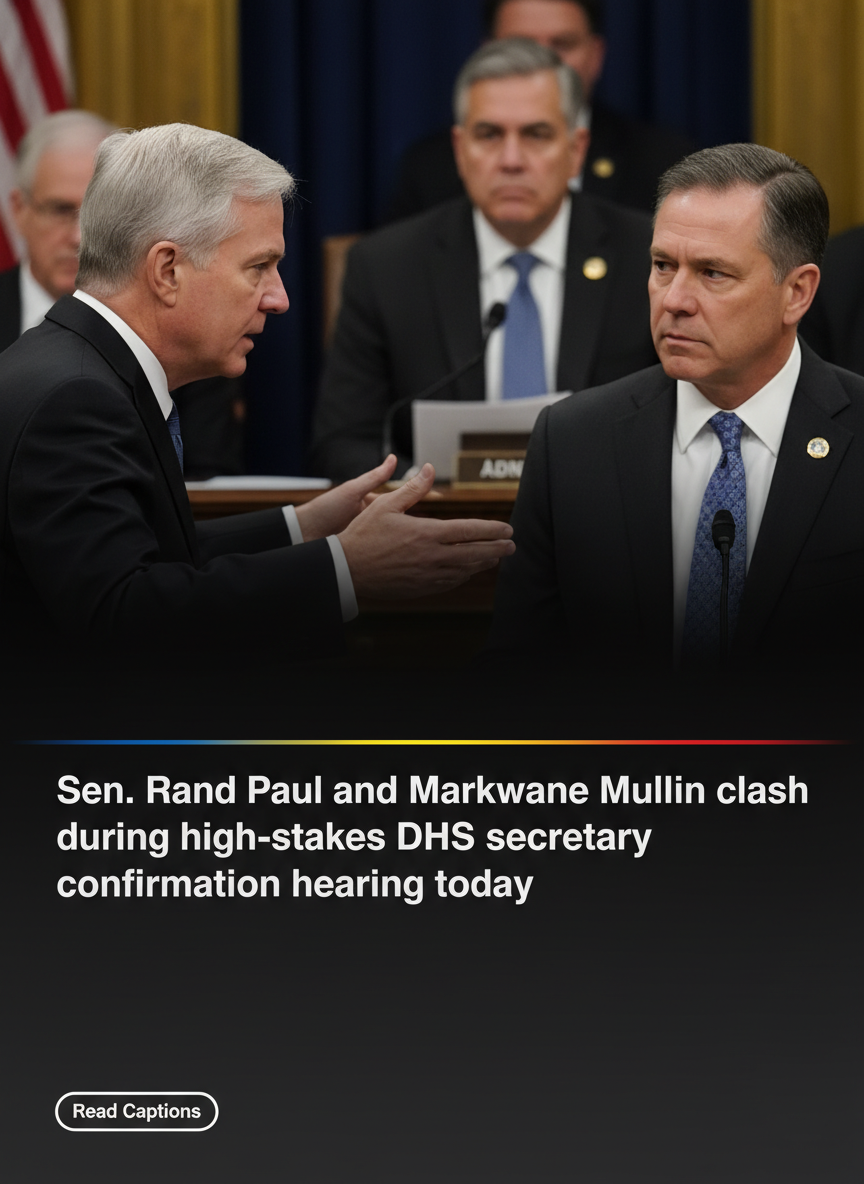
Clash of Conservatives: Rand Paul Grills DHS Nominee Markwayne Mullin in High-Stakes Confirmation Hearing
WASHINGTON — The Senate Homeland Security and Governmental Affairs Committee became the stage for a fiery ideological showdown on Wednesday as Senator Markwayne Mullin (R-OK) appeared for his confirmation hearing to serve as the next Secretary of the Department of Homeland Security (DHS). The hearing, marked by sharp exchanges and visible tension, reached a boiling point when Senator Rand Paul (R-KY) took the floor to challenge his colleague’s fitness for the Cabinet post.
A Sudden Shift in Leadership
Mullin, a former MMA fighter and plumber turned Senator, was tapped for the role following the withdrawal of the original nominee, Kristi Noem. The transition from Noem to Mullin was intended to provide a more “bruiser-style” leadership to the DHS, an agency currently grappling with historic border challenges and internal restructuring. However, Mullin’s path to confirmation hit a significant roadblock in the form of Senator Paul, whose libertarian-leaning brand of conservatism often puts him at odds with the more hawkish wings of the Republican party.
The Confrontation: Civil Liberties vs. National Security
The most explosive moment of the hearing occurred when Senator Paul questioned Mullin on his history of supporting expanded government surveillance and his past comments regarding the use of military force on domestic soil. Paul, a staunch advocate for privacy rights, pressed Mullin on whether he would use the vast powers of the DHS to target political dissidents.
“We are talking about the most powerful law enforcement apparatus in the world,” Paul said, leaning forward and gesturing toward Mullin. “The American people need to know if you view the DHS as a shield to protect them, or a sword to be used against those who disagree with the administration. Your record suggests a preference for the latter.”
Mullin, known for his blunt and often combative communication style, did not back down. He defended his record, arguing that the current global threat landscape requires “decisive and unapologetic action.”
“Senator, I’ve spent my life in the private sector and in this chamber fighting for the security of this country,” Mullin responded, his voice rising. “I don’t need a lecture on the Constitution. I know what it takes to keep a border closed and a country safe, and I’m not going to apologize for wanting to give our officers the tools they need to do their jobs.”
Tensions Boil Over
The exchange quickly devolved into a series of interruptions, with Committee Chairman Gary Peters (D-MI) forced to interject several times to restore order. The friction between Paul and Mullin highlighted a deepening rift within the GOP regarding the reach of the “administrative state”—a topic that has become a lightning rod in recent confirmation cycles.
Observers noted that the confrontation was particularly striking given that both men serve on the same side of the aisle. The intensity of the debate suggested that Mullin may face a more difficult confirmation path than the White House initially anticipated, as several other Republican senators appeared to echo Paul’s concerns regarding executive overreach.
Policy Priorities and the Path Ahead
Outside of the fireworks with Senator Paul, Mullin used the hearing to outline a “Day One” agenda focused almost exclusively on border enforcement. He pledged to resume construction of the border wall and to implement a “zero-tolerance” policy for illegal crossings. He also addressed the morale crisis within the DHS, promising to be a “secretary who stands in the trenches” with Customs and Border Protection (CBP) agents.
While Mullin is still expected to garner significant support from the GOP caucus, the “Paul Factor” introduces a layer of uncertainty. If Paul decides to lead a formal opposition or filibuster, the administration may need to court moderate Democrats to ensure Mullin’s seat at the Cabinet table.
Conclusion
The confirmation hearing of Markwayne Mullin has laid bare the internal tensions of a Republican party caught between its populist-nationalist wing and its constitutional-libertarian roots. As the Committee moves toward a vote, all eyes will be on whether Mullin’s “tough-guy” persona—which served him well in the octagon and on the Senate floor—will be an asset or a liability in leading one of the nation’s most complex and scrutinized federal departments.
The Senate Homeland Security and Governmental Affairs Committee is expected to vote on the nomination early next week.