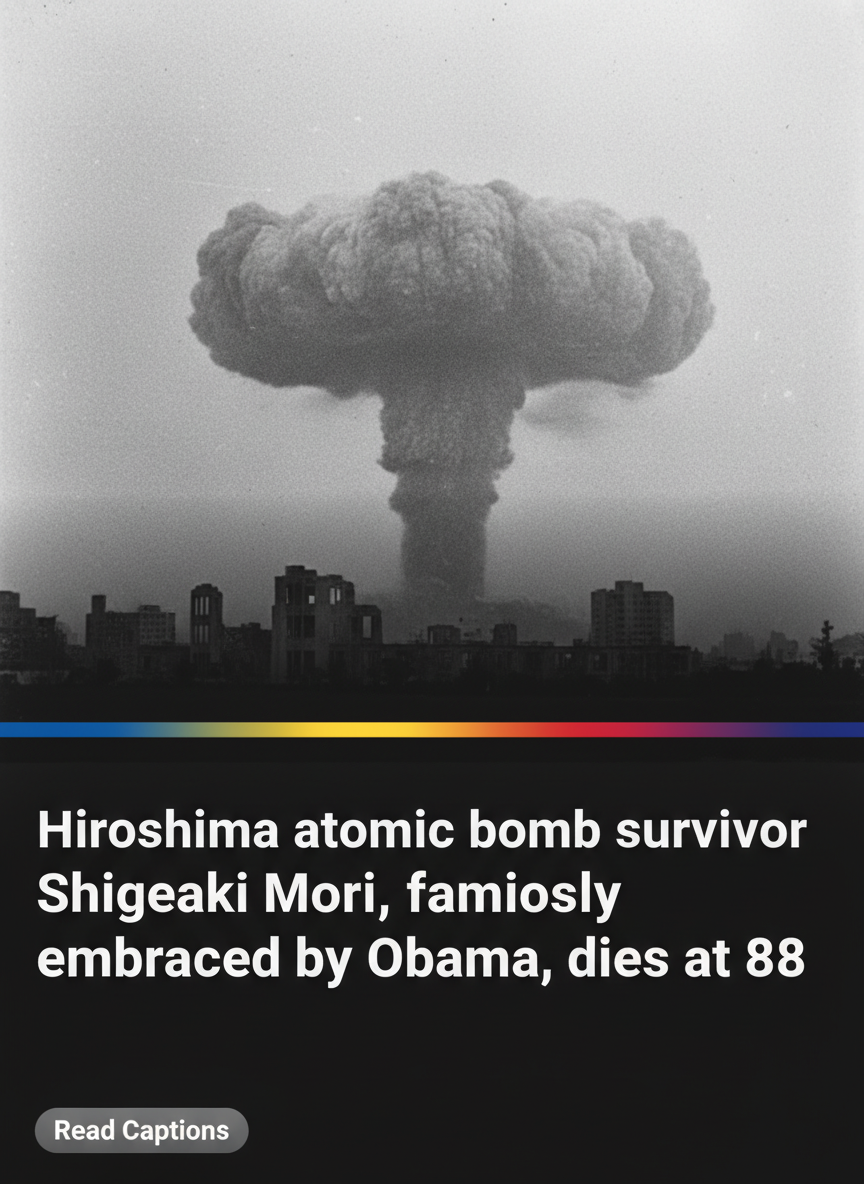
The Man Who Embraced History: Shigeaki Mori, Hiroshima Survivor and Peace Advocate, Dies at 88
HIROSHIMA, Japan — Shigeaki Mori, the Hiroshima atomic bomb survivor whose emotional embrace with President Barack Obama in 2016 became a global symbol of reconciliation and the enduring hope for a nuclear-free world, has died. He was 88.
Mori passed away peacefully, leaving behind a legacy that transcended his own survival. While he was known to the world for a single, unscripted moment of humanity on a global stage, his life’s work was dedicated to a quiet, decades-long quest to honor the forgotten victims of the world’s first nuclear attack—including the American enemies who died alongside his neighbors.
A Childhood Shattered by Light
On the morning of August 6, 1945, Mori was just eight years old. He was walking to school, approximately 1.5 miles from the hypocenter of the blast, when the “Little Boy” atomic bomb detonated over Hiroshima. The explosion knocked him off a bridge and into a river, a moment of chaos that would define the trajectory of his life.
Mori survived the immediate blast and the subsequent “black rain,” but the trauma of that day stayed with him. Like many hibakusha (atomic bomb survivors), he lived through the agonizing aftermath of radiation sickness and the rebuilding of a city that had been reduced to ash. However, Mori chose to turn his survival into a mission of historical preservation.
The Guardian of Lost Souls
While much of the world focused on the Japanese casualties of the bombing, Mori spent over 30 years researching a lesser-known tragedy: the 12 American prisoners of war who were held in Hiroshima and killed by the U.S. bomb.
A self-taught historian, Mori used his own resources to track down the families of these American airmen. He navigated complex military bureaucracies and language barriers to ensure that the names of the U.S. servicemen were officially recognized as victims at the Hiroshima Peace Memorial. He often stated that his goal was to ensure no family was left wondering what happened to their loved ones, regardless of which side of the war they fought on.
The Embrace That Moved the World
In May 2016, Mori’s life work was thrust into the international spotlight. Barack Obama became the first sitting U.S. president to visit Hiroshima, delivering a speech at the Peace Memorial Park that called for a “moral awakening” regarding nuclear weapons.
Following the speech, Obama approached Mori. As the elderly survivor began to weep, the President reached out and pulled him into a somber, lengthy embrace. The image of the American leader holding a survivor of the American bomb flashed across television screens and newspapers worldwide. For many, it represented a final, symbolic closing of the wounds of World War II.
“The President gestured as if he was going to hug me, so I just put my head on his chest,” Mori recalled in interviews following the event. He noted that the gesture felt like a validation of his decades of work for peace and the recognition of all victims.
A Legacy of Reconciliation
In his later years, Mori continued to speak out against the proliferation of nuclear weapons, warning that the world must never forget the horror he witnessed as a child. His story was featured in the 2016 documentary Paper Lanterns, which chronicled his journey to find the families of the American POWs.
With Mori’s passing, the number of living hibakusha continues to dwindle, raising concerns in Japan about how the memory of the atomic bombings will be preserved for future generations. However, Mori’s life stands as a testament to the power of individual empathy to bridge the deepest of national divides.
He is survived by his family and a global community of peace activists who view his life not just as a story of survival, but as a blueprint for how to turn historical grief into a bridge for human connection.