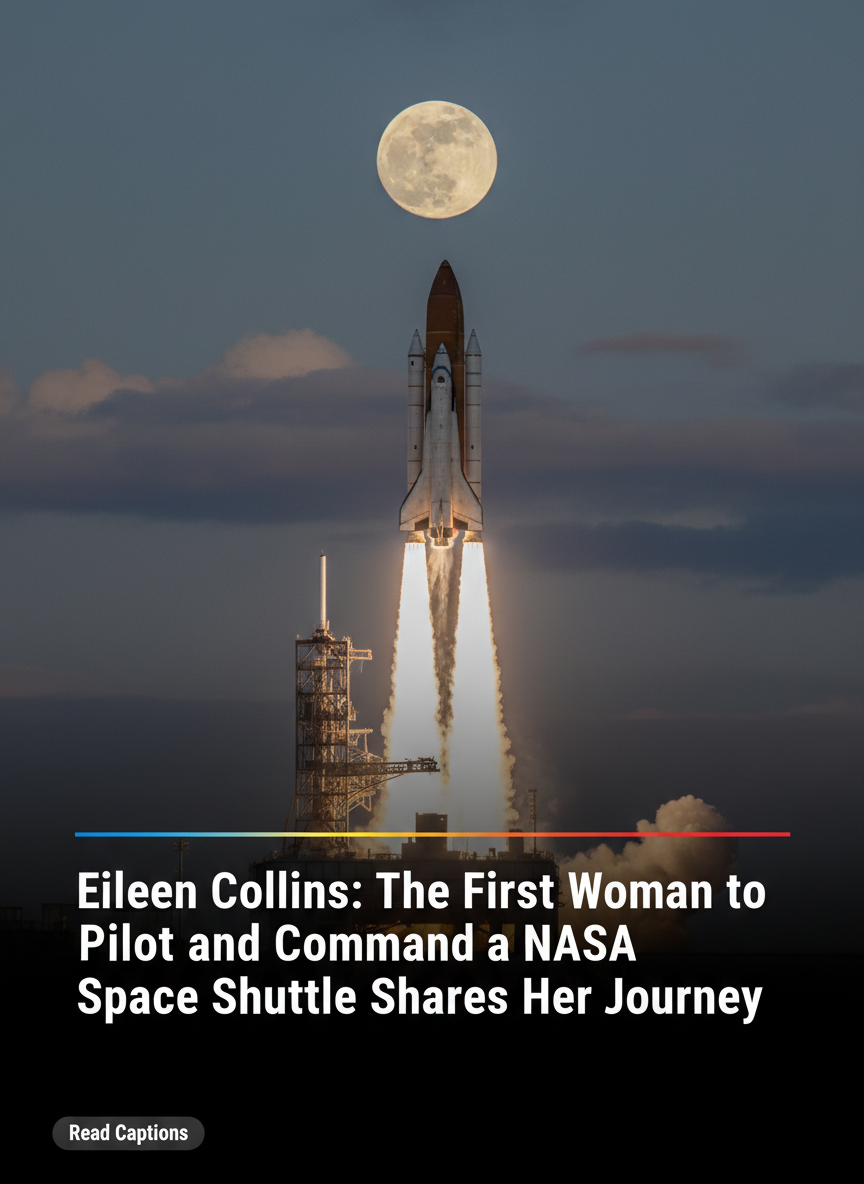
Breaking the Celestial Ceiling: Retired Astronaut Eileen Collins Reflects on a Career of Firsts
In the annals of space exploration, few names carry as much weight as Colonel Eileen Collins. As a pioneer who navigated both the cockpit of high-performance military jets and the flight deck of the Space Shuttle, Collins did more than just fly; she shattered expectations. In a recent interview on CBS Saturday Morning, the retired NASA astronaut and U.S. Air Force Colonel sat down to reflect on her historic journey and the legacy she left behind among the stars.
A Trailblazer in the Cockpit
Long before she became a household name at NASA, Eileen Collins was making waves in the United States Air Force. Joining at a time when women were just beginning to enter the world of military aviation, she served as a flight instructor and a test pilot. It was this rigorous background that prepared her for the ultimate challenge: piloting the most complex flying machine ever built.
In 1995, Collins made history as the first woman to pilot a Space Shuttle mission (STS-63). The mission, which involved a historic rendezvous with the Russian space station Mir, proved to the world that the gender of the person at the controls was irrelevant—only skill and precision mattered. “I didn’t want to be the ‘female’ pilot,” Collins noted during her discussion. “I wanted to be the best pilot.”
Taking Command
The transition from pilot to commander is one of the most significant leaps in an astronaut’s career, requiring not only technical mastery but also exceptional leadership. In 1999, Collins once again broke the glass ceiling—or rather, the celestial one—by becoming the first woman to command a Space Shuttle mission (STS-93). The mission was tasked with deploying the Chandra X-ray Observatory, a massive telescope that continues to provide scientists with unprecedented views of the universe.
Reflecting on that moment, Collins described the immense responsibility of leading a crew into the vacuum of space. She emphasized that while the title of “first” was an honor, her primary focus was always the safety of her crew and the success of the mission. Her calm demeanor under pressure became a hallmark of her leadership style, inspiring a new generation of women to pursue careers in STEM and aerospace.
A Legacy That Reaches Beyond Earth
During her appearance on CBS Saturday Morning, Collins discussed the evolution of the space program and the importance of representation. She noted that while she may have been the first, she certainly did not want to be the last. Today, as NASA prepares for the Artemis missions—which aim to land the first woman and the first person of color on the lunar surface—Collins sees her career as a bridge to this more inclusive future.
“The barriers are there to be broken,” Collins said, encouraging young dreamers to look upward. She highlighted that the path she carved out was built on the foundation of those who came before her, such as the Mercury 13, and is now being expanded by the diverse cohort of astronauts currently training for deep-space exploration.
Conclusion: The Journey Continues
Eileen Collins’ story is not just one of personal achievement, but a testament to the power of perseverance and the pursuit of excellence. From the windswept runways of Air Force bases to the silent expanse of Earth’s orbit, her career serves as a roadmap for anyone aiming to reach the impossible. As NASA looks toward Mars and beyond, the trailblazing spirit of Colonel Eileen Collins remains a guiding light, reminding us all that the sky is no longer the limit.
For more stories on space and innovation, stay tuned to CBS News.