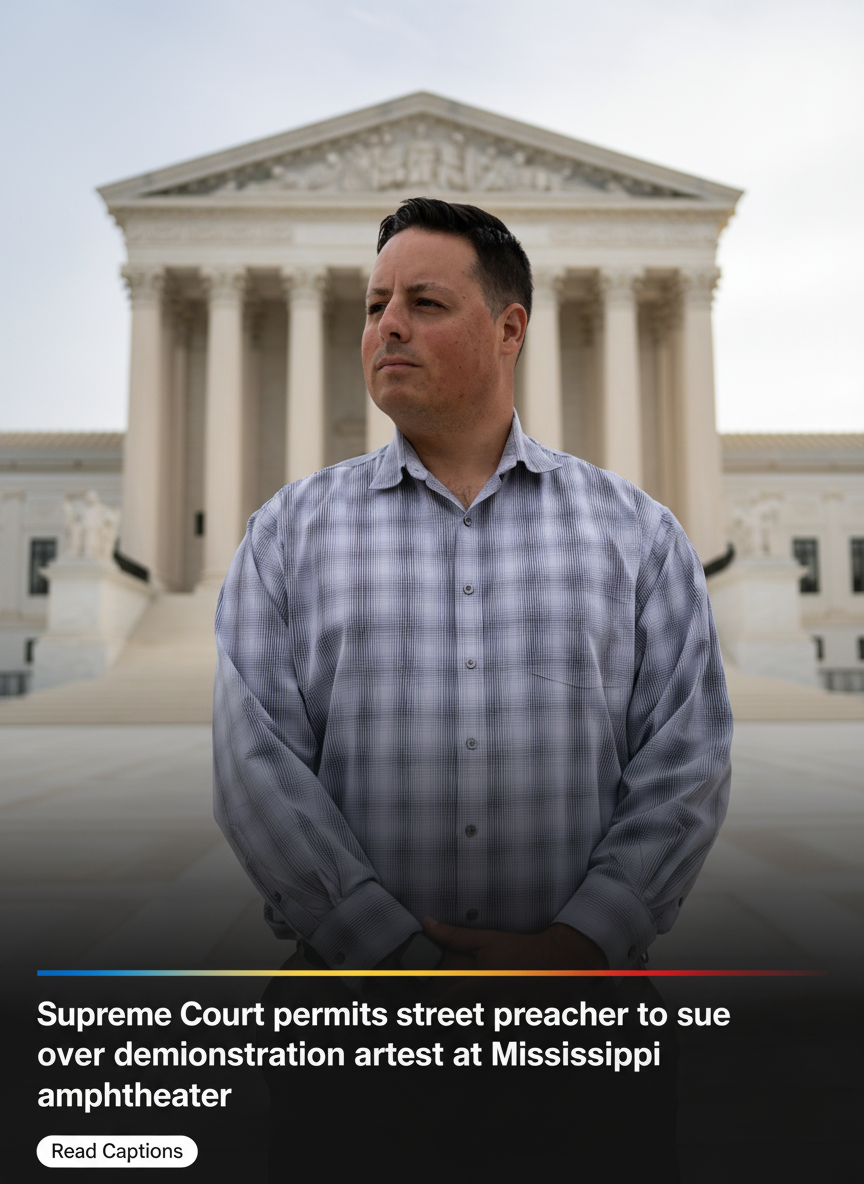
Voices in the Plaza: Supreme Court Revives Street Preacher’s First Amendment Challenge
By Our Political Correspondent | March 20, 2026
A Victory for the Sidewalk Pulpit
WASHINGTON — In a significant victory for religious expression and public speech, the Supreme Court ruled on Friday that Gabriel Olivier, a street preacher from Mississippi, can proceed with his lawsuit against the city of Brandon. The decision vacates a lower court ruling that had initially dismissed Olivier’s claims, breathing new life into a legal battle that pits local public order ordinances against the foundational rights of the First Amendment.
The case, Olivier v. City of Brandon, centers on an incident outside the Brandon Amphitheater, a prominent entertainment venue in central Mississippi. Mr. Olivier was arrested after refusing to leave a designated “no-demonstration zone” while attempting to share religious messages with concertgoers. City officials argued at the time that the ordinance was a necessary “time, place, and manner” restriction designed to ensure public safety and the flow of traffic during high-capacity events.
The Conflict at the Amphitheater
The dispute began during a summer concert series in 2024. Mr. Olivier, often seen with a megaphone and printed pamphlets, had positioned himself on a public sidewalk near the entrance of the amphitheater. Police officers, citing a city ordinance that bans demonstrations within 500 feet of the venue’s gates, ordered Olivier to move to a designated “free speech zone” located nearly a quarter-mile away.
When Mr. Olivier refused, asserting that the sidewalk was a traditional public forum, he was handcuffed and charged with disorderly conduct and violating the municipal code. Although the criminal charges were later dropped, Mr. Olivier filed a civil rights lawsuit, alleging that the city’s ordinance was unconstitutionally broad and specifically targeted religious speech.
The High Court’s Reasoning
While the Supreme Court did not issue a final ruling on the constitutionality of the ordinance itself, the majority opinion clarified that the lower courts had erred in dismissing the case prematurely. Writing for the majority, the Court noted that the “physical characteristics and historical use” of the area surrounding the amphitheater suggest it may indeed function as a public forum where the government’s power to restrict speech is severely limited.
“The right to speak in the public square does not vanish simply because a city builds a fence and a ticket booth nearby,” the opinion stated. “Mr. Olivier has presented a plausible claim that the city of Brandon overstepped its authority by pushing dissenting voices out of sight and out of mind.”
Implications for Local Ordinances
Legal experts suggest that this ruling could have a ripple effect across the country, particularly for municipalities that have increasingly used “buffer zones” to manage protests outside of government buildings, clinics, and entertainment venues. By allowing Mr. Olivier’s lawsuit to proceed to discovery, the Court is signaling a renewed skepticism toward local laws that sequester speech to remote or invisible corners of the public square.
“This is a clear message to cities that they cannot simply zone out the First Amendment,” said Sarah Jenkins, a constitutional law professor at the University of Mississippi. “The Court is reaffirming that if you are on a public sidewalk, your right to speak is at its zenith, regardless of whether a city finds your message disruptive or inconvenient.”
Conclusion
In Brandon, news of the Supreme Court’s decision was met with mixed reactions. City attorneys maintained that they acted in the interest of public safety, while supporters of Mr. Olivier hailed the move as a win for “the little guy.”
For Gabriel Olivier, the ruling is the first step toward what he hopes will be a permanent injunction against the ordinance. “I wasn’t there to cause trouble; I was there to share the gospel,” Olivier said in a brief statement following the announcement. “The Constitution doesn’t have a ‘concert exception.’”
The case now returns to the U.S. District Court for the Southern District of Mississippi, where a full trial on the merits of the ordinance is expected later this year.