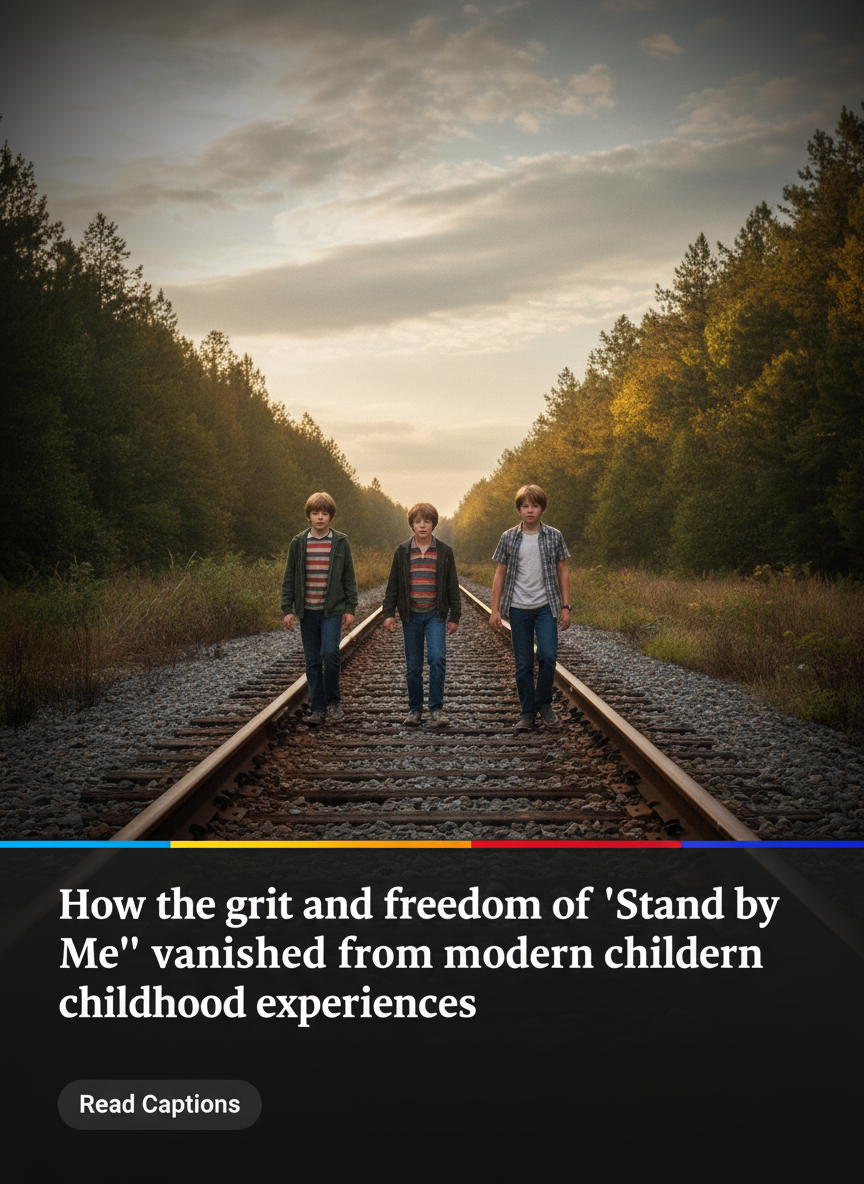
The End of the Free-Range ‘Stand by Me’ Childhood: Why the 1986 Classic Now Feels Like Science Fiction
By Editorial Staff | Published March 22, 2026
In the summer of 1986, four young boys set out on a trek across the Oregon woods to find a missing person’s body. They carried nothing but a canteen, some bedrolls, and the weight of their own coming-of-age secrets. There were no GPS trackers, no check-in texts, and no “Find My” apps. Their only tether to the world was their friendship.
As Rob Reiner’s cinematic masterpiece Stand by Me celebrates its 40th anniversary this year, the film has shifted from a nostalgic period piece to something more akin to a historical relic. For modern audiences, the “free-range” childhood depicted in the Stephen King adaptation feels less like a memory and more like a lost civilization.
The Digital Tether
The starkest difference between the world of Gordie, Chris, Teddy, and Vern and the youth of 2026 is the presence of the screen. In a recent analysis of the film’s enduring legacy, critics point out that the central tension of the story—the physical and emotional isolation of the boys—would be impossible today. In a world of ubiquitous connectivity, the “adventure” would have been interrupted by a dozen push notifications or a parental FaceTime call within the first mile of the railroad tracks.
Sociologists argue that the “digital tether” has fundamentally altered the development of independence. Where the boys in Stand by Me had to resolve their own conflicts and navigate physical dangers without adult intervention, today’s children are often under “constant, benevolent surveillance,” as one expert described it. The result is a generation that is safer from physical harm but perhaps more susceptible to the anxieties of constant social comparison.
Risk, Boredom, and the Great Outdoors
Stephen King’s original novella, The Body, and Reiner’s film adaptation both leaned heavily into the concept of “productive boredom.” The boys’ journey was born out of a lack of options—there were no video games to play and no infinite scrolls to consume. This boredom forced a confrontation with their inner lives and their community’s social hierarchies.
Today, the “dead time” required for such self-reflection is often filled by algorithmic content. “We’ve traded the risk of the woods for the safety of the sofa,” says Dr. Elena Aris, a child psychologist. “But in doing so, we’ve also traded the mastery that comes from navigating the world on one’s own terms. The boys in the movie were dealing with heavy themes—grief, abuse, and neglect—but they were dealing with them through movement and brotherhood.”
The Parental Paradigm Shift
The film also highlights a seismic shift in parenting styles. In the 1950s setting of the film (and the 1980s era of its release), “free-range” parenting wasn’t a movement; it was simply the status quo. Parents expected their children to be gone for hours, if not days, provided they returned by the time the streetlights came on.
In 2026, the cultural pendulum has swung toward intensive parenting. Fears of “stranger danger”—statistically lower now than in previous decades—and the hyper-competitive nature of modern adolescence have turned the casual trek into a scheduled, supervised activity. The autonomy that defined the Stand by Me experience has become a luxury, or in some cases, a cause for a call to social services.
Conclusion: Can We Go Back?
As we look back on 40 years of Stand by Me, the film serves as a poignant reminder of what has been lost in the digital age. While technology has provided unprecedented safety and information, it has also narrowed the boundaries of the physical world for the young.
The iconic final line of the film—”I never had any friends later on like the ones I had when I was twelve. Jesus, does anyone?”—resonates differently now. It’s no longer just a tribute to the intensity of childhood friendship; it’s a eulogy for a type of freedom that may never return. If we want the next generation to have their own “Stand by Me” moments, we may have to do the hardest thing for a modern parent: put down the phone, look away, and let them get lost.