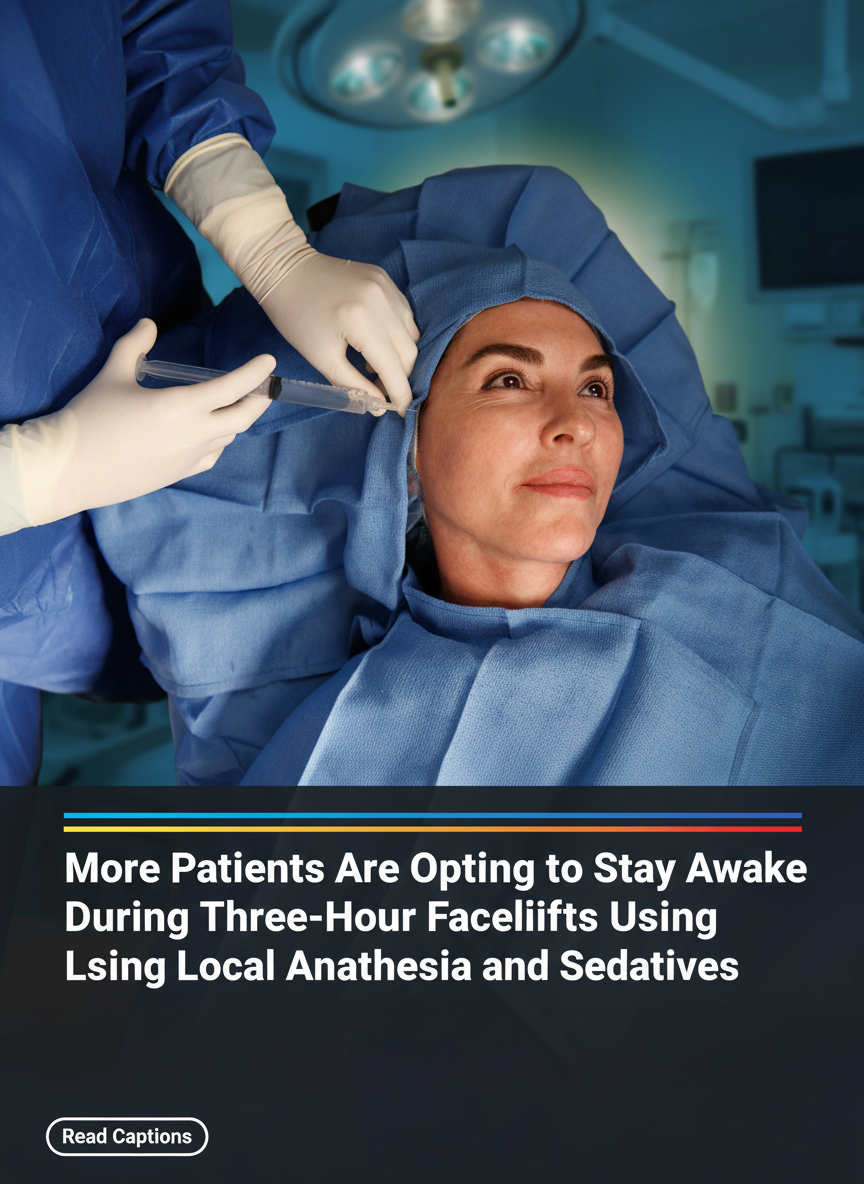
‘I Could Hear Them Working on Me’: Why NYC Patients Are Choosing to Stay Awake During 3-Hour Facelifts
In a high-end surgical suite overlooking Park Avenue, the atmosphere is surprisingly casual. There is no heavy machinery beeping rhythmically for a ventilator, no intubation tubes, and no deep, drug-induced unconsciousness. Instead, there is the soft hum of Top 40 radio and the occasional sound of a patient asking for a sip of water.
This is the new face of New York City plastic surgery. A growing number of New Yorkers are eschewing general anesthesia in favor of staying awake during invasive procedures, including the grueling three-hour facelift.
The “Twilight” Transformation
The method, which has gained significant traction according to a recent report by the New York Post, utilizes a combination of potent local numbing agents and oral sedatives. Patients aren’t “wide awake” in the traditional sense; rather, they exist in a semi-lucid “twilight” state. They alternate between light dozing and moments of clarity where they can hear the snip of surgical scissors and the muffled conversations of the medical team.
“It’s a strange sensation, but not a painful one,” says one 54-year-old patient who recently underwent the procedure. “I knew they were working on me. I could hear the instruments. But I felt like I was wrapped in a warm blanket of calm. I even remember laughing at a joke the nurse made halfway through.”
Safety and the “Anesthesia Hangover”
The shift toward awake surgery is driven largely by a desire to avoid the “anesthesia hangover”—the nausea, grogginess, and cognitive fog that often follow general anesthesia. By remaining conscious, patients bypass the risks associated with being “put under,” such as respiratory depression and rare but serious complications like blood clots or malignant hyperthermia.
Medical professionals note that the recovery time is drastically reduced. Without the need for a recovery room stay to “wake up” the central nervous system, many patients are able to walk out of the clinic under their own power shortly after the final stitch is placed.
The Surgeon’s Advantage
It isn’t just the patients who prefer this method; surgeons are finding clinical benefits as well. When a patient is under general anesthesia, their facial muscles are completely slack, which can sometimes make it difficult to gauge the most natural-looking tension for a lift.
“When the patient is awake, I can ask them to smile, grimace, or blink,” explains one Manhattan-based plastic surgeon. “This real-time feedback allows us to ensure symmetry and avoid the ‘over-tightened’ look that many patients fear. It turns a static procedure into a dynamic one.”
Overcoming the “Ick” Factor
Despite the benefits, the idea of being conscious while a surgeon repositions facial tissue is enough to make many squeamish. The success of the “awake” movement relies heavily on patient selection. Doctors say it requires a certain level of mental fortitude and a trusting relationship between the patient and the surgical team.
To manage anxiety, clinics often use a curated environment—weighted blankets, noise-canceling headphones, or even Virtual Reality headsets—to distract the patient from the clinical reality of the operating table.
The Future of Elective Surgery
As medical technology and numbing protocols continue to evolve, the “awake facelift” is likely to transition from a niche trend to a standard offering. In a city that prizes efficiency and “tweakments” with minimal downtime, the ability to undergo major structural surgery and still be home in time for dinner is becoming the ultimate luxury.
While the thought of hearing your own surgery might remain a hurdle for the faint of heart, for many New Yorkers, the benefits of a faster recovery and a safer experience are worth keeping their eyes—and ears—open.