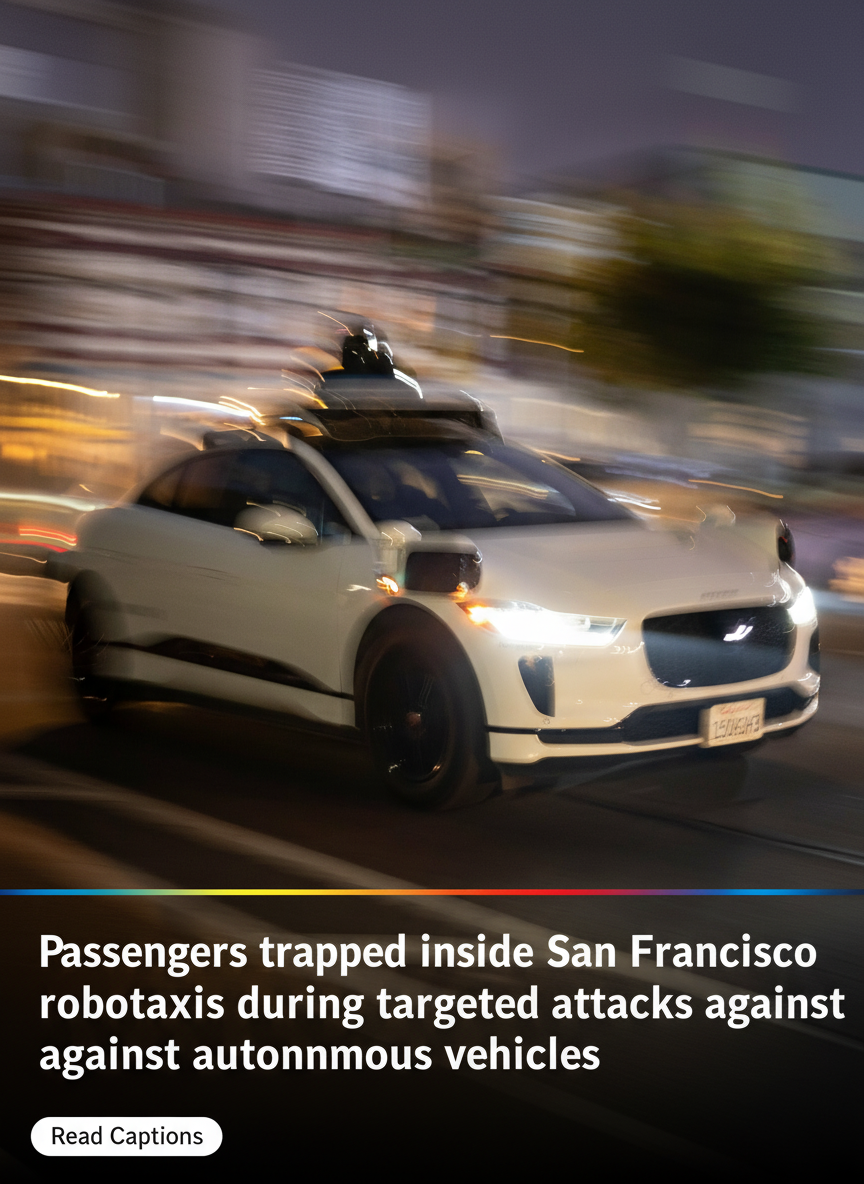
Locked In: The New Human Toll of San Francisco’s Anti-Robot Uprising
SAN FRANCISCO — For Elena Rodriguez, the ride home from a Tuesday dinner in the Mission District was supposed to be a silent, routine trip in the back of a Waymo autonomous taxi. Instead, it became a thirty-minute exercise in claustrophobic terror.
As the vehicle approached Market Street, it was swarmed by a group of roughly a dozen masked protesters. Within seconds, the car’s sensors, overwhelmed by people standing too close, triggered an emergency halt. Then the hammers came out. While the protesters smashed the exterior cameras and spray-painted the windshield, Rodriguez sat behind reinforced glass, unable to open the doors as the vehicle’s security protocol shifted into a “hard lockdown” mode.
“I was screaming at the internal camera for help, hitting the ‘unlock’ button on the screen, but nothing happened,” Rodriguez said. “The car was designed to keep people out, but in that moment, it felt like it was designed to keep me in while the world was ending outside the window.”
A Rising Tide of Techno-Skepticism
The incident is part of a harrowing new trend in San Francisco, where the friction between a high-tech future and a frustrated local population has turned violent. While “coning”—the practice of placing traffic cones on car hoods to disable them—was the hallmark of 2023 and 2024, the protests of 2026 have taken a darker, more physical turn.
Anti-robot activists, citing everything from job displacement to privacy concerns and the “gentrification of the curb,” have begun targeting autonomous vehicles (AVs) with passengers inside. The goal, according to some activist manifestos, is to make the technology “uninsurable and socially intolerable.”
The Safety Paradox
The core of the issue lies in a fundamental safety paradox. When an autonomous vehicle detects a threat or a malfunction, its primary directive is to stop and secure the cabin. For the tech companies, this means locking the doors to prevent carjackers or protesters from entering the vehicle and harming the passenger.
However, when a mob surrounds the car, this “safety feature” becomes a cage. Passengers have reported that the manual door releases—often hidden or mechanically complex to prevent accidental use at high speeds—are difficult to locate under duress. Furthermore, once the external sensors are vandalized or covered in paint, the car’s “brain” effectively goes blind, refusing to move or unlock until a remote operator can verify it is safe to do so.
“The software is programmed for a world of rules,” said Marcus Thorne, a robotics safety consultant. “It isn’t programmed for a world where people are actively trying to dismantle the machine while a human is inside. The car is following its safety script, but that script didn’t account for the psychological trauma of being trapped during an assault.”
Industry and City Response
In a statement released Wednesday, Waymo called the recent attacks “unacceptable acts of domestic vandalism that put innocent commuters at risk.” The company emphasized that its remote assistance teams are available 24/7, though Rodriguez noted it took over ten minutes to reach a human dispatcher during her ordeal.
San Francisco city officials find themselves in a difficult position. Law enforcement is struggling to respond to these “flash mob” style attacks, which are coordinated on encrypted apps and dissipate before police arrive. Mayor London Breed’s office has faced increasing pressure to provide “safety corridors” for autonomous transit, a move that critics say prioritizes tech corporations over the safety of general pedestrians.
The Road Ahead
As the legal battles over AV safety and urban integration continue, the human cost is mounting. For many San Franciscans, the sight of a driverless car is no longer a symbol of progress, but a lightning rod for civil unrest.
As for Elena Rodriguez, she has deleted her ride-sharing apps. “I used to think the scariest thing about these cars was that there was no one behind the wheel,” she said. “Now I know the scariest thing is that when you’re inside one, you have no control at all.”
Reported by the Technology Desk.