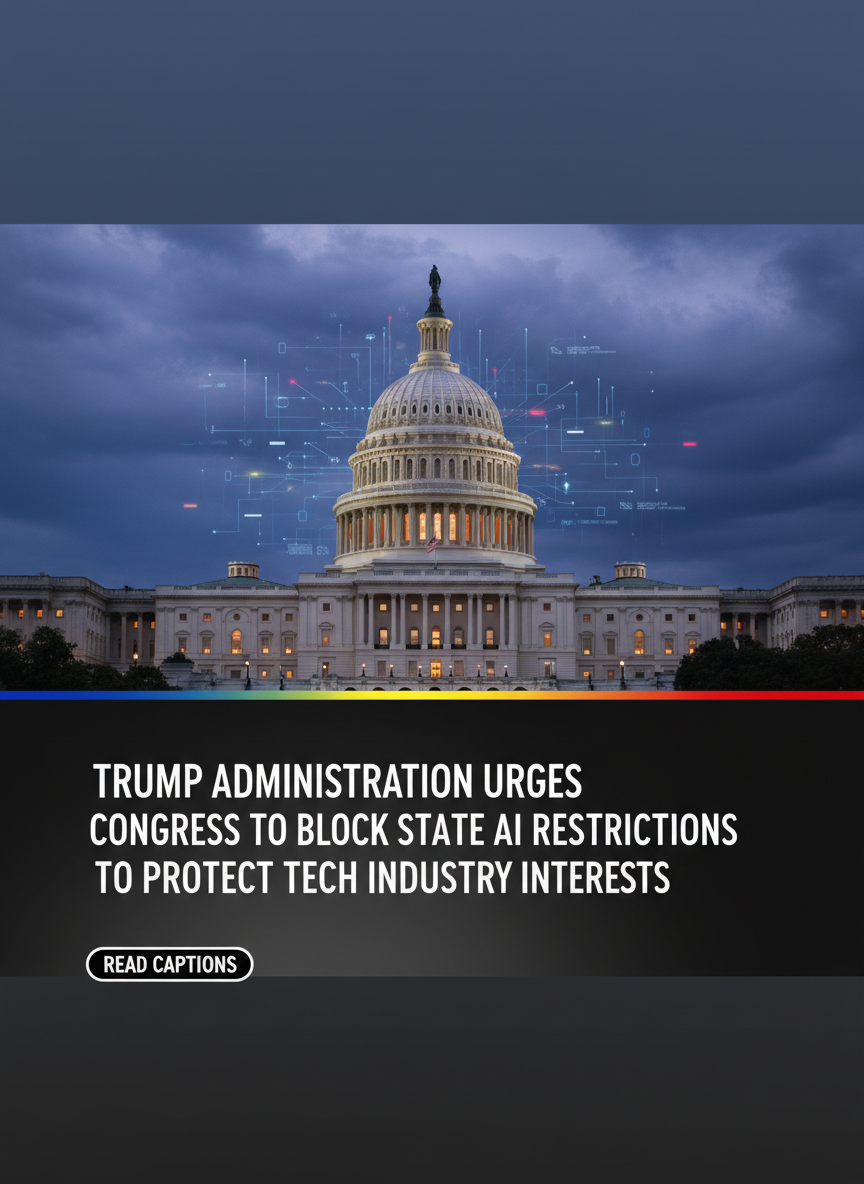
Trump Administration Urges Congress to Preempt State AI Restrictions, Citing National Security and Innovation
By Political Correspondent | March 20, 2026
The Push for Federal Preemption
In a move that sets the stage for a major constitutional and regulatory showdown, the Trump administration on Friday formally requested that Congress pass legislation to block states from implementing their own restrictions on artificial intelligence. The proposal, spearheaded by top White House policy advisers, aims to establish a single federal standard for AI development, effectively stripping states of their power to regulate the burgeoning technology.
White House officials argue that a “patchwork” of state-level regulations—ranging from safety mandates to transparency requirements—threatens to stifle American innovation and allow global competitors like China to seize the lead in the AI arms race. “We cannot allow fifty different sets of rules to anchor down the most important economic engine of the 21st century,” said a senior administration official during a briefing Friday morning.
Protecting Corporate Interests and National Competitiveness
The proposed federal framework is designed to codify policies that protect the interests of major AI developers and tech giants. Industry leaders have long lobbied for federal preemption, arguing that complying with varying laws across state lines is both technically impossible and prohibitively expensive. By consolidating oversight at the federal level, the administration seeks to provide “regulatory certainty” for Silicon Valley and emerging AI hubs.
Advisers within the Trump administration view AI as a cornerstone of national security. The move to block state limits is seen as a way to ensure that safety protocols do not slow down the deployment of large-scale language models and autonomous systems. Proponents of the plan suggest that excessive caution at the state level could lead to a “brain drain,” where top researchers and capital flee to more permissive jurisdictions or overseas.
A Growing Rift with Republican Governors
The administration’s push has hit an unexpected roadblock: opposition from within its own party. For months, a coalition of Republican governors and influential conservative voices has championed “states’ rights” as the primary defense against perceived AI risks, including digital censorship and the erosion of privacy.
Governors from states like Texas and Florida have previously expressed concern that unchecked AI could be weaponized by “woke” corporations to influence public discourse. Some have even introduced their own state-level bills to mandate political neutrality in AI algorithms. This latest federal move is being viewed by some GOP leaders as an overreach that undermines the core conservative principle of federalism.
“While we support American innovation, we cannot surrender our state’s authority to protect our citizens from the potential biases and privacy intrusions of Big Tech,” said a spokesperson for one prominent Republican governor. “Federalism exists for a reason, and AI should not be the exception.”
The Path Ahead in Congress
The legislative battle is expected to be fierce. While the administration’s proposal enjoys the support of many pro-business Republicans and some moderate Democrats who fear losing ground to China, it faces a fragile coalition of critics. This includes progressive Democrats concerned about AI safety and labor displacement, as well as the aforementioned “states’ rights” conservatives.
Technology lobbyists are already descending on Capitol Hill to frame the debate as a choice between American dominance and technological decline. Conversely, civil liberties groups and state attorneys general are preparing for potential legal challenges, arguing that the federal government lacks the authority to broad-brush preempt state consumer protection laws.
Conclusion
As the Trump administration moves to centralize AI authority, it is forcing a re-evaluation of the traditional boundaries between federal power and state sovereignty. The outcome of this legislative push will not only determine the future of the American tech industry but will also serve as a landmark moment in the legal history of the digital age. For now, the world’s most powerful AI companies are watching closely, hoping for a clear path forward in an increasingly complex political landscape.