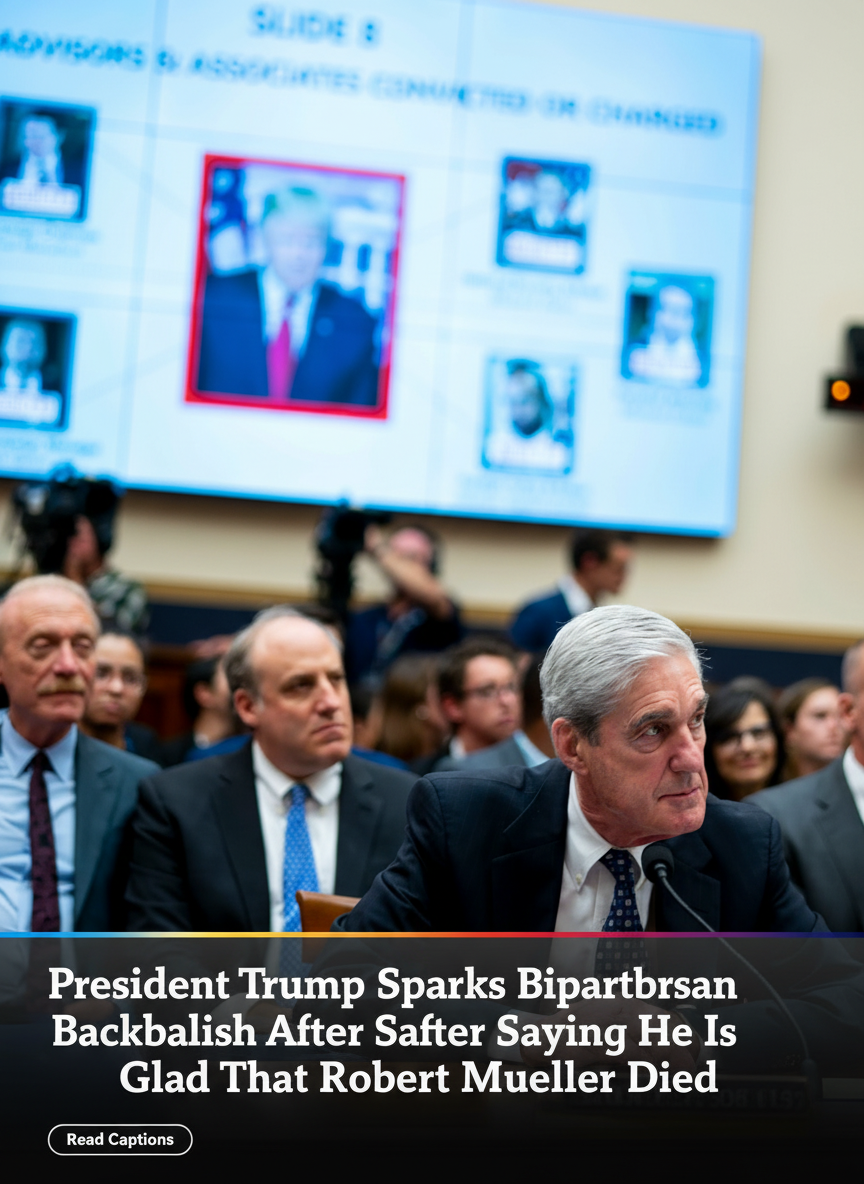
“Good, I’m Glad”: Trump Sparks Outrage with Blunt Reaction to Robert Mueller’s Death
WASHINGTON — President Donald J. Trump ignited a fresh wave of bipartisan criticism on Saturday following his unfiltered response to the passing of Robert S. Mueller III, the former FBI Director and Special Counsel who led the investigation into Russian interference in the 2016 election.
Speaking to reporters on the tarmac before boarding Air Force One, the President was asked for his thoughts on the news of Mr. Mueller’s death at the age of 81. Mr. Trump, who spent years characterizing the Mueller investigation as a “witch hunt,” did not offer the traditional expressions of sympathy or reflection on public service typically expected from a sitting commander-in-chief.
“Good, I’m glad,” Mr. Trump said, pausing briefly as the engines of the presidential aircraft hummed in the background. “He was a very central part of the biggest scam in the history of our country. He tried to take down a presidency, and he failed. I don’t have a lot of respect for people who do that.”
A Final Grievance
The President’s comments underscored a grudge that has remained remarkably potent more than seven years after the Special Counsel’s report was released. Mr. Mueller, a decorated Vietnam War veteran who served as the Director of the F.B.I. under both Presidents George W. Bush and Barack Obama, had lived a largely private life since his 2019 testimony before Congress.
While allies of Mr. Mueller praised him on Saturday as a “paragon of integrity” and a “dedicated public servant,” Mr. Trump’s reaction served as a stark reminder of the deep scars left by the investigation. During his remarks, the President doubled down on his long-standing grievances, suggesting that Mr. Mueller’s legacy was defined entirely by the “Russia, Russia, Russia” probe.
Bipartisan Condemnation
The reaction from Capitol Hill was swift and sharply divided, though a notable number of Republicans joined Democrats in rebuking the President’s lack of decorum. Senator Mitt Romney, Republican of Utah, issued a statement calling the President’s remarks “beneath the dignity of the office.”
“Robert Mueller served this nation in uniform and in the halls of justice with unwavering commitment,” Mr. Romney said. “To celebrate the passing of a dedicated American patriot is not only unseemly, it is a stain on our national discourse.”
Democratic leaders were more pointed. Representative Hakeem Jeffries, the House Minority Leader, characterized the President’s comments as “vile and pathetic.” He added, “Donald Trump’s inability to show human decency, even in the face of death, proves once again that he is unfit to lead a nation that values honor and sacrifice.”
A Pattern of Post-Mortem Attacks
For those who have followed Mr. Trump’s political career, the comments were not entirely surprising. The President has a documented history of disparaging his rivals and critics after their deaths. He famously continued to attack Senator John McCain months after the Arizona Republican’s passing in 2018 and has leveled similar posthumous criticisms against figures ranging from Representative Elijah Cummings to General Colin Powell.
Historians note that this behavior represents a significant break from the “presidential code,” a set of unwritten rules where successors and predecessors generally maintain a level of respect for those who have served the state, regardless of political animosity.
Reflecting on a Complex Legacy
Despite the firestorm at the White House, tributes for Mr. Mueller poured in from former colleagues in the Department of Justice. They remembered him as a “straight-arrow” prosecutor who took on the most difficult assignments without regard for political fallout.
As the nation prepares for Mr. Mueller’s funeral services, the President’s remarks have ensured that the contentious debates of the past decade will remain front and center. While Mr. Trump’s base may see his bluntness as a sign of authenticity, for many others, it served as a jarring reminder of the polarization that continues to define the American political landscape.
The White House later issued a brief formal statement that did not mention the President’s verbal remarks, instead stating that “the administration acknowledges Mr. Mueller’s decades of service to the country.”