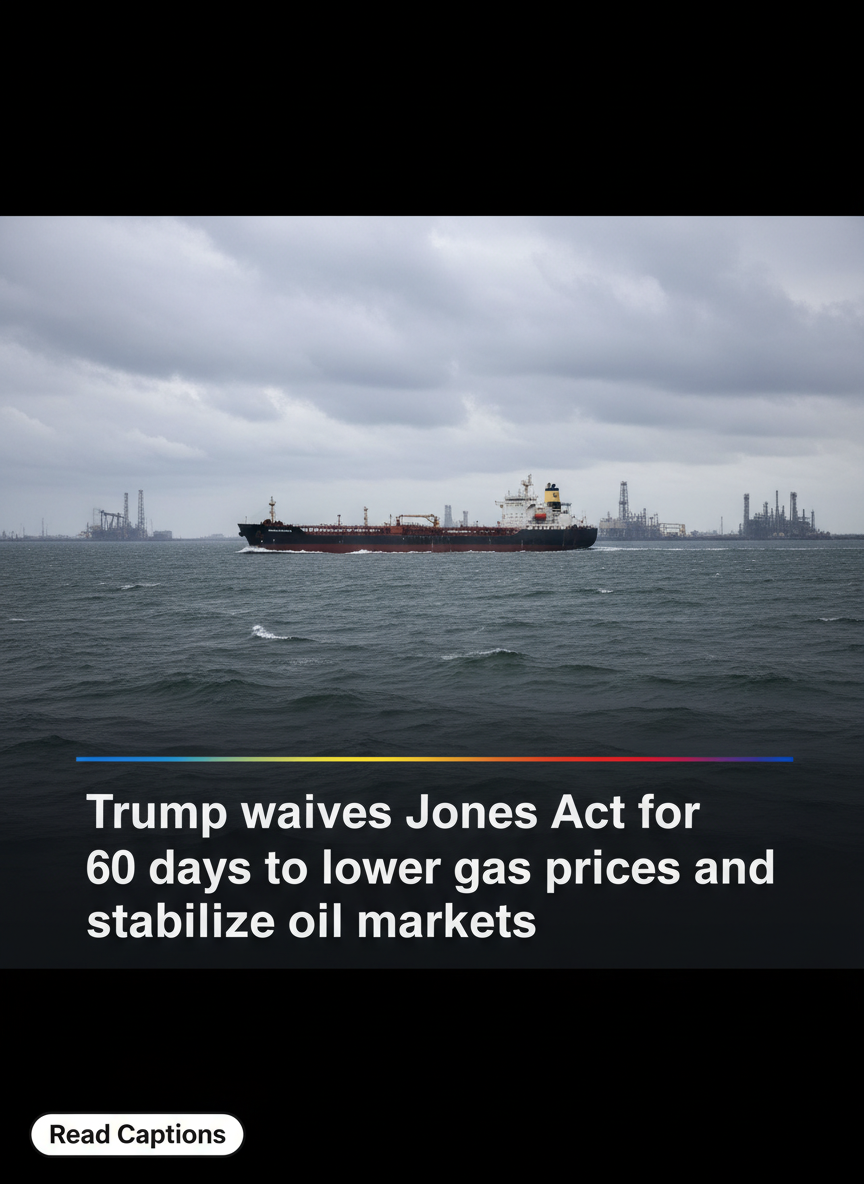
Trump Issues Emergency 60-Day Jones Act Waiver to Stabilize Oil Market Amid Rising Tensions
WASHINGTON D.C. — In a decisive move to address skyrocketing gasoline prices and mounting volatility in the global energy sector, President Trump announced on Wednesday a 60-day emergency waiver of the Jones Act. The executive action is designed to streamline the transport of petroleum products between U.S. ports by allowing foreign-flagged vessels to assist in domestic distribution, a move the administration hopes will provide immediate relief at the pump.
Easing the Pressure on American Consumers
The decision comes as the national average for gasoline prices reached record highs this week, fueled by supply chain disruptions and escalating geopolitical instability. By suspending the century-old shipping law, the White House aims to increase the available fleet of tankers capable of moving crude oil and refined products from the Gulf Coast to high-demand regions like the Northeast and the West Coast.
“We are taking bold action to ensure that American families are not penalized by market fluctuations beyond their control,” the President stated during a briefing. “By temporarily lifting these restrictions, we are opening up the lanes of commerce and ensuring that our energy resources can move freely and efficiently across the country.”
The Role of Geopolitical Tensions
While the administration cited “market stabilization” as the primary goal, analysts point to the worsening conflict in the Middle East as the underlying catalyst. According to reports from CNBC, the recent escalation of hostilities involving Iran has sparked fears of a prolonged disruption in the Strait of Hormuz—a vital artery for global oil shipments. This uncertainty has sent Brent and West Texas Intermediate (WTI) crude prices into a tailspin, prompting the U.S. to look inward for logistical flexibility.
The 60-day window is intended to act as a “pressure valve,” allowing the U.S. energy infrastructure to adapt to the shifting global landscape without being hamstrung by the domestic shipping requirements typically mandated by federal law.
Understanding the Jones Act
Formalized as the Merchant Marine Act of 1920, the Jones Act requires that all goods transported by water between U.S. ports be carried on ships that are U.S.-built, U.S.-owned, and U.S.-crewed. While the law is intended to support the domestic maritime industry and bolster national security, critics have long argued that it creates bottlenecks during energy crises by limiting the number of available tankers.
This is not the first time the act has been waived; previous administrations have issued temporary suspensions following major hurricanes or pipeline shutdowns. However, the scope of the current waiver—tied specifically to a wartime footing and global price surges—highlights the severity of the current energy outlook.
Industry and Political Reaction
The move has been met with a mix of relief and caution. Energy advocates and retail groups have praised the waiver, suggesting it will lower transportation costs that are often passed on to consumers. “In a time of crisis, flexibility is our greatest asset,” said a spokesperson for the American Fuel & Petrochemical Manufacturers.
Conversely, domestic maritime unions and some lawmakers have expressed concern that the waiver could undermine the U.S. shipping industry and set a precedent for bypassing “America First” labor protections. Supporters of the Jones Act argue that the domestic fleet is sufficient and that the waiver serves as a temporary fix for a much larger strategic problem.
Looking Ahead
The waiver is set to expire in 60 days, though the administration has signaled that an extension remains on the table should market conditions fail to improve. For now, the focus remains on the immediate logistics of moving millions of barrels of oil to regions facing the tightest supply.
As the first foreign vessels begin to enter domestic routes, all eyes will be on the national gas price average to see if this regulatory relief translates into savings for the American taxpayer. For a global market already on edge, the Jones Act suspension represents a critical attempt by the U.S. to insulate its economy from the tremors of international conflict.