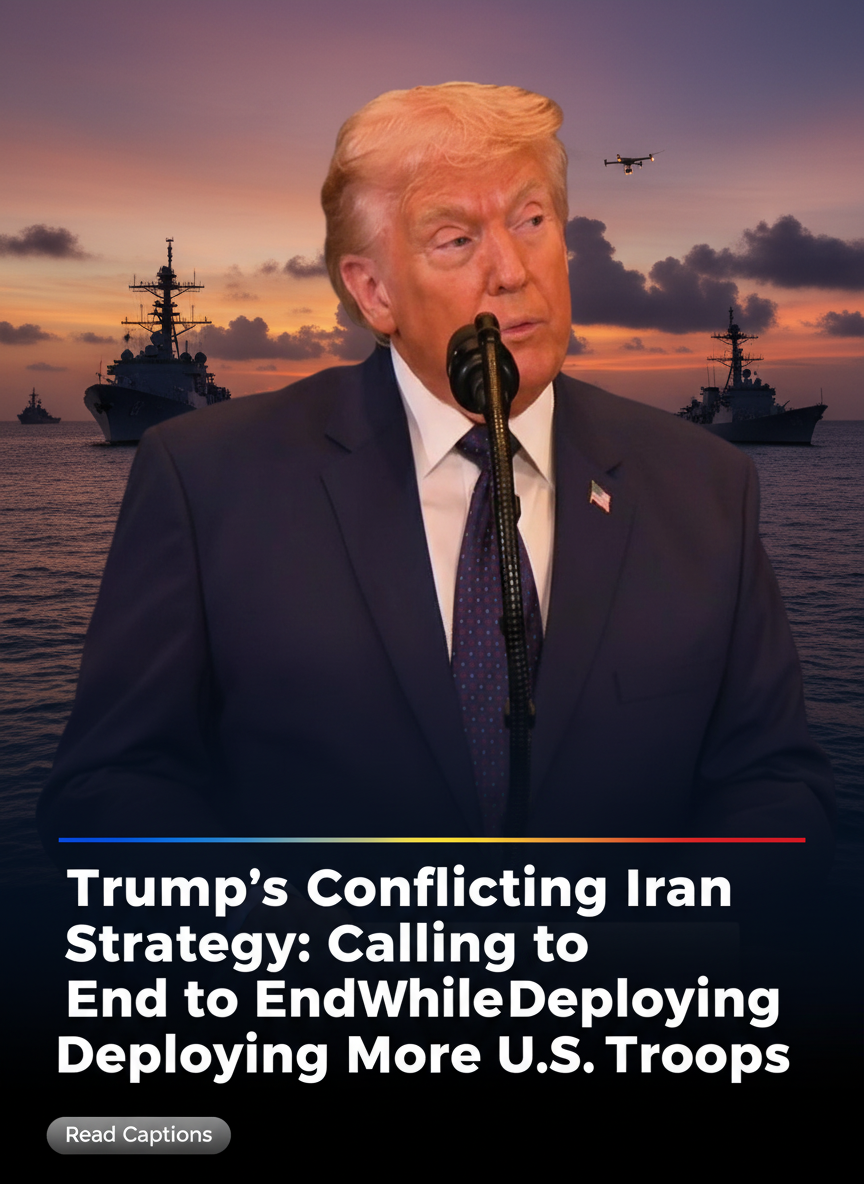
Contradiction at the Core: Trump’s Dueling Narratives on Iran Leave Allies and Critics Bewildered
WASHINGTON D.C. — In the span of a single afternoon, the White House’s stance on Iran shifted from the prospect of diplomatic de-escalation to the cold reality of military reinforcement. This “whiplash diplomacy” has become a hallmark of President Donald Trump’s foreign policy, leaving international allies, domestic lawmakers, and even his own advisors scrambling to identify the administration’s true north.
The Duality of Friday’s Message
On Friday, President Trump showcased the full spectrum of his unpredictable approach to the Middle East. During a series of public appearances and social media interactions, the President suggested a willingness to “wind down” potential conflicts and even hinted at the possibility of easing economic sanctions if Tehran showed a willingness to negotiate. “I’m not looking for war,” Trump told reporters, leaning into his long-standing campaign promise to end “forever wars.”
However, the olive branch was quickly followed by a show of force. Within hours of these conciliatory remarks, the administration confirmed the deployment of 1,500 additional troops to the Middle East. While the Pentagon described the move as a “defensive” measure to protect existing forces from alleged Iranian threats, the juxtaposition of peace-leaning rhetoric with boots-on-the-ground reality created a jarring narrative conflict.
A Strategy of “Good Cop, Bad Cop”
Political analysts are divided on whether these mixed messages are a calculated negotiation tactic or a symptom of a divided cabinet. Some observers suggest Trump is playing a one-man game of “good cop, bad cop,” using the threat of military might to force Iran to the table while simultaneously offering an exit ramp through diplomacy.
“The President likes to keep his adversaries guessing,” says one senior foreign policy analyst. “By appearing both eager for peace and ready for war, he believes he maintains the upper hand. The problem is that in high-stakes nuclear diplomacy, ambiguity can lead to dangerous miscalculations by the other side.”
Internal Friction and External Confusion
The internal dynamics of the Trump administration further complicate the message. While the President frequently voices a desire to bring troops home, his more hawkish advisors—including National Security Advisor John Bolton and Secretary of State Mike Pompeo—have consistently pushed for a “maximum pressure” campaign. This internal tug-of-war often manifests as contradictory statements issued within the same day.
For Iran, the signals are equally confusing. Officials in Tehran have responded with a mix of defiance and skepticism, stating that they cannot negotiate with an administration that “speaks with two voices.” Meanwhile, European allies, who are still attempting to salvage the 2015 nuclear deal, find themselves caught in the middle of a policy that seems to change with the news cycle.
The Human and Economic Cost
Beyond the geopolitical chess match, the “mixed message” approach has tangible consequences. The deployment of 1,500 troops represents a significant commitment of resources and places more American service members in a volatile region. Simultaneously, the uncertainty surrounding sanctions continues to rattle global oil markets and complicates the economic recovery of the region.
Conclusion: A Policy of Unpredictability
As the administration moves forward, the fundamental question remains: Is there a cohesive strategy beneath the contradictions? President Trump’s ability to pivot from threats of “obliteration” to offers of “tea and conversation” is unprecedented in modern American diplomacy.
While the President views this unpredictability as a strength that prevents the U.S. from being “taken advantage of,” critics argue that it erodes American credibility. For now, the world watches the Persian Gulf with bated breath, waiting to see which version of the Trump doctrine—the peacemaker or the commander-in-chief—will prevail in the coming months.