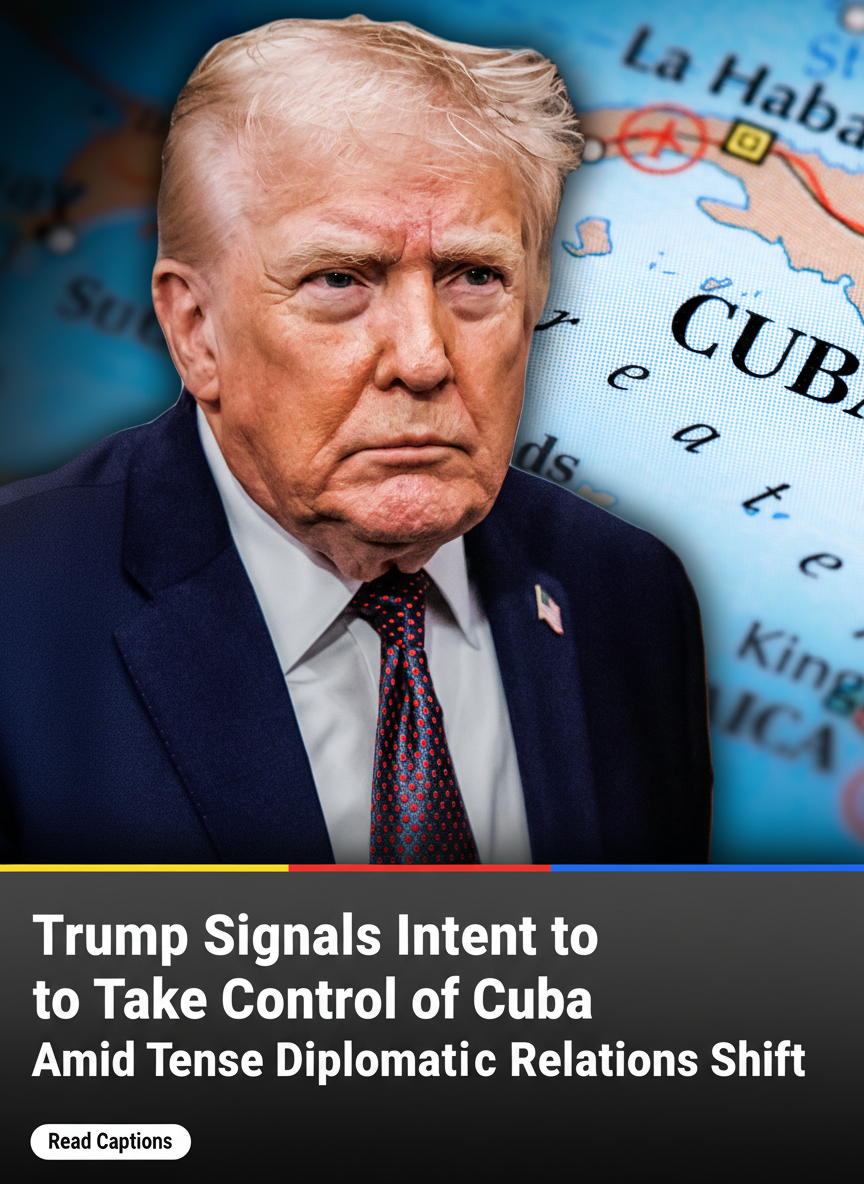
The “Cuba Question”: President Trump Ignites Global Debate with Vow to “Take” the Island Nation
WASHINGTON D.C. — In a move that has sent shockwaves through the diplomatic community and redefined the geopolitical landscape of the Caribbean, President Donald Trump has revealed a startling expectation regarding the future of Cuba. In a series of recent statements, the President suggested that the United States intends to “take Cuba” in some form, marking one of the most aggressive shifts in U.S. foreign policy toward the island since the Cold War began.
A Sudden Shift in Rhetoric
The President’s comments come at a time when many observers expected a delicate dance of diplomacy. Instead, Trump has pivoted toward a stance of direct assertion. While the specific nature of what “taking” the island entails—whether through economic dominance, political pressure, or territorial acquisition—remains vaguely defined, the rhetoric alone has shattered the status quo.
The timing of these statements is particularly striking. For the past several months, representatives from both Washington and Havana had been engaged in quiet dialogues aimed at improving bilateral relations and easing long-standing trade restrictions. Those talks now appear to be in jeopardy as the administration adopts a more confrontational posture.
The 67-Year Shadow
To understand the gravity of the President’s remarks, one must look back to 1959. For 67 years, the relationship between the two nations has been defined by the shadow of Fidel Castro’s revolution, which overthrew a government that was then a staunch, albeit controversial, U.S. ally. Since that turning point, Cuba has remained a symbolic and literal thorn in the side of American foreign policy, sitting just 90 miles off the coast of Florida.
President Trump’s recent assertions tap into a decades-old tension. By suggesting a move to “take” the island, he is effectively signaling an end to the “wait-and-see” approach that has characterized multiple administrations. Critics argue this could lead to a dangerous escalation, while supporters see it as a necessary correction to decades of failed containment strategies.
Diplomacy Interrupted
The immediate fallout of this shift has been felt in the halls of the State Department. Prior to these statements, there was a budding hope for “normalization”—a process that began under previous leadership and seemed to be continuing in fits and starts. The opening of markets and the potential for increased travel were on the horizon.
However, the President’s new “take” doctrine suggests that the U.S. is no longer interested in mere participation in the Cuban economy, but rather in a fundamental transformation of the island’s status. This has left international allies and Cuban officials scrambling to decipher whether this represents a literal threat of intervention or a high-stakes bargaining chip in a larger geopolitical game.
Geopolitical and Economic Implications
Why now? Analysts suggest several factors could be driving the President’s focus on Havana. From a security standpoint, the presence of adversarial influence in the Caribbean remains a concern for the Pentagon. Economically, the potential for development on the island—often referred to as a “time capsule” of the 1950s—presents a lucrative, if complicated, opportunity for American interests.
Furthermore, the domestic political landscape cannot be ignored. The “Cuba Question” remains a pivotal issue for voters in Florida, a key battleground state where the exile community holds significant influence. A hardline stance against the current regime in Havana often resonates deeply with this demographic.
Conclusion: A High-Stakes Future
As the dust settles on these controversial remarks, the world watches the Florida Straits with renewed apprehension. President Trump has never been one for traditional diplomacy, often preferring to disrupt established norms to achieve his objectives. By placing Cuba back in the crosshairs of American ambition, he has ensured that the island will remain at the center of the global stage for the foreseeable future.
Whether this leads to a new era of American influence in Havana or a return to the dark days of the Cuban Missile Crisis remains to be seen. For now, the “Cuba Question” is no longer a matter of historical debate, but a pressing issue of modern global security.