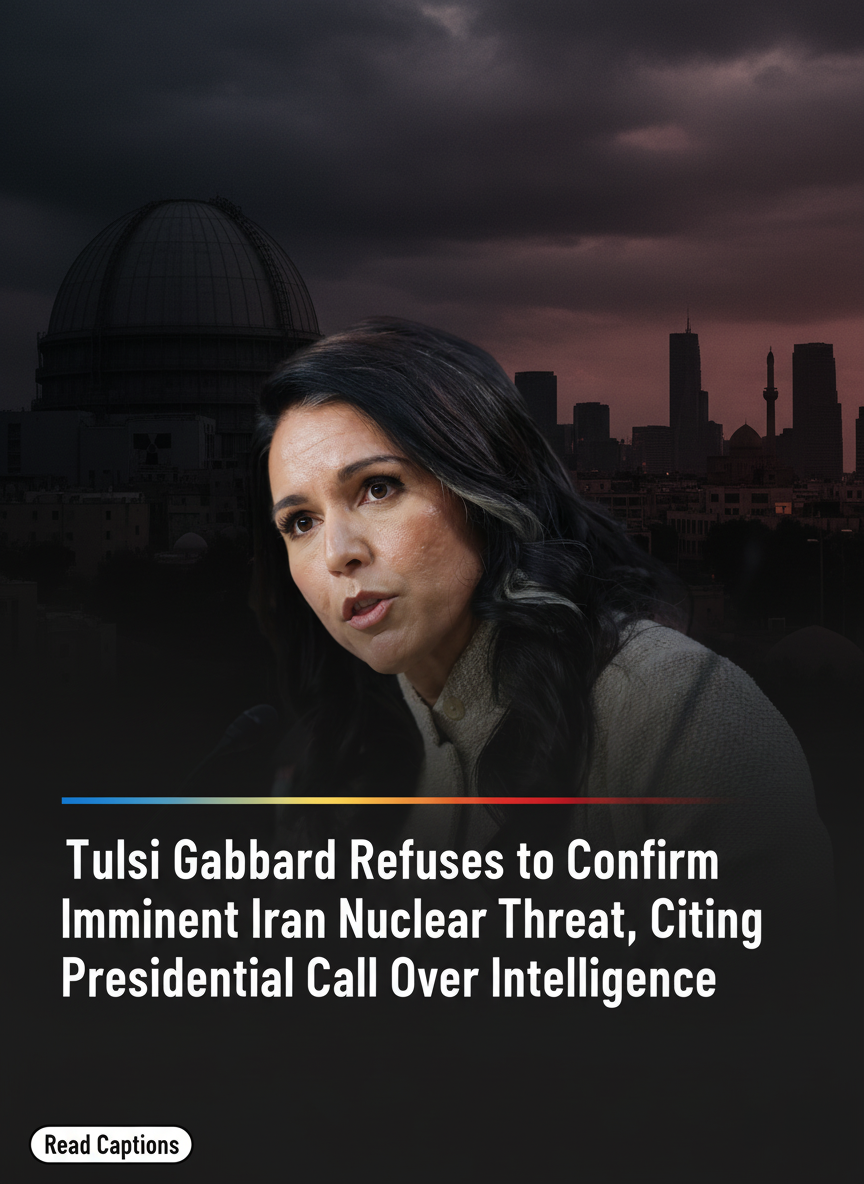
‘The President’s Call’: DNI Tulsi Gabbard Defers to Trump on Imminence of Iran Nuclear Threat
WASHINGTON — Director of National Intelligence Tulsi Gabbard sparked a firestorm on Wednesday after declining to confirm whether Iran poses an “imminent” nuclear threat, despite recent rhetoric from the White House suggesting a crisis is at hand. In a move that highlights a shifting dynamic between the executive branch and the nation’s spy agencies, Gabbard asserted that the final determination of a national security threat lies with President Trump, not the intelligence community.
A Question of Imminence
During a high-profile appearance, Gabbard was pressed on the specific nature of Iran’s nuclear capabilities. The line of questioning followed a series of briefings from White House officials who have characterized Tehran’s nuclear program as an “imminent” danger to the United States and its allies—a designation that often serves as a legal and political precursor to military action.
When asked directly if the intelligence she oversees supports the “imminent” label, Gabbard sidestepped the binary. She emphasized that while the intelligence community provides raw data and situational analysis, the interpretation of that data into a “threat level” is a matter of executive judgment.
Intelligence vs. Policy
“The role of the intelligence community is to provide the facts and the best possible analysis of what is happening on the ground,” Gabbard stated. “But whether those facts constitute an ‘imminent threat’ is a policy determination that rests with the Commander-in-Chief. It is the President’s call, not the intelligence community’s, to define the threshold for action.”
The stance marks a significant departure from previous administrations, where the Director of National Intelligence typically worked to present a unified front with the White House regarding threat assessments. Gabbard’s comments suggest a new “America First” doctrine within the intelligence apparatus—one that prioritizes presidential discretion over the consensus of career analysts.
Critics and Supporters React
The Director’s refusal to echo the White House’s specific terminology has drawn mixed reactions on Capitol Hill. Critics argue that Gabbard is abdicating the DNI’s responsibility to provide an objective check on executive power. “The intelligence community exists to speak truth to power, even when that truth is inconvenient,” said one senior member of the House Intelligence Committee. “By deferring the definition of a threat to the President, we risk politicizing our national security.”
Conversely, supporters of the administration have praised Gabbard for her restraint. They argue that for too long, the “Deep State” has used selective intelligence to box presidents into specific foreign policy outcomes. To these observers, Gabbard is simply restoring the constitutional hierarchy by placing the burden of decision-making back on the elected leader.
The Global Stakes
The semantic debate over the word “imminent” has real-world consequences. Under international law and domestic war powers acts, the classification of a threat as “imminent” can be used to justify preemptive strikes or the deployment of additional troops without immediate congressional approval. By keeping the definition fluid, the Trump administration maintains a high degree of strategic ambiguity, though it leaves allies and adversaries alike guessing about the U.S.’s “red lines.”
Conclusion
As tensions with Iran continue to simmer, Tulsi Gabbard’s latest comments underscore a broader transformation within the U.S. intelligence landscape. By positioning the DNI as a provider of information rather than a final arbiter of threat levels, Gabbard is centralizing power within the Oval Office. Whether this leads to a more agile foreign policy or a dangerous disconnect between data and action remains a subject of intense national debate.
For more updates on national security and the intelligence community, stay tuned to our ongoing coverage.