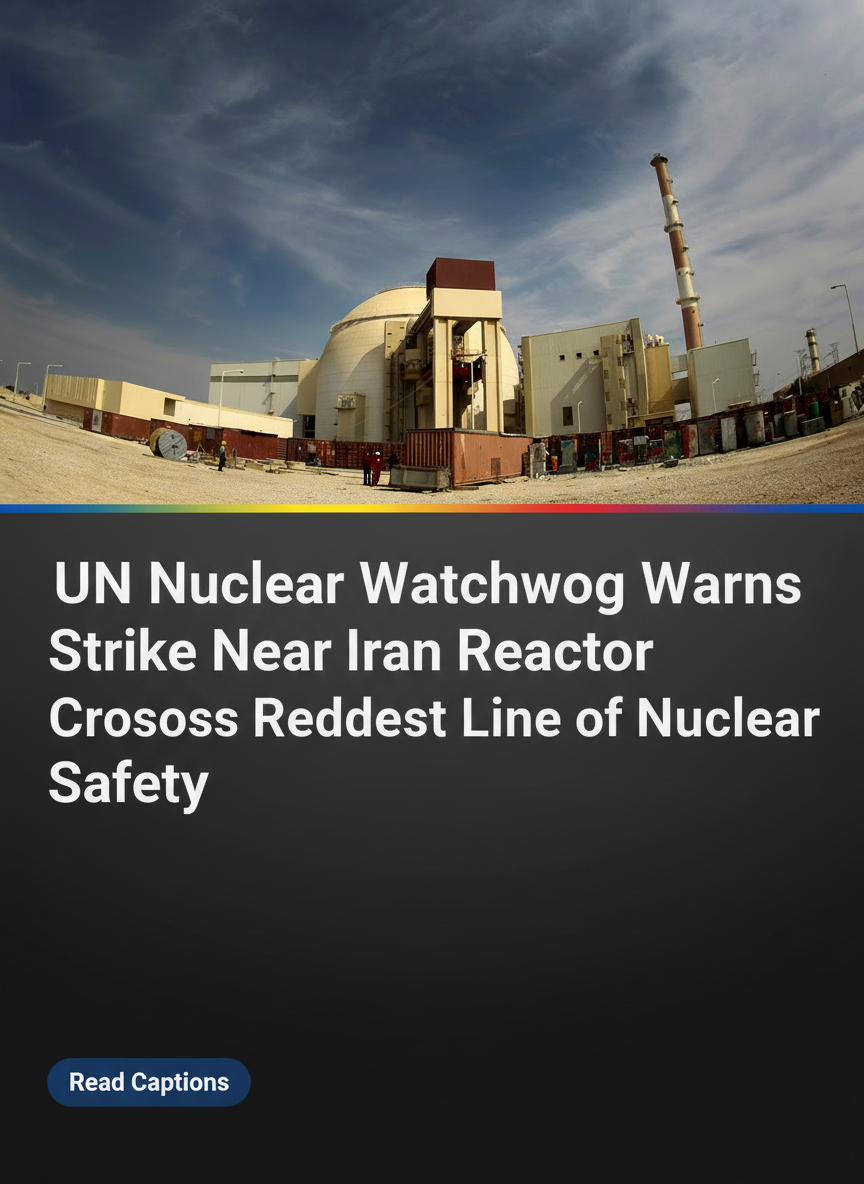
IAEA Chief Warns Strike Near Iranian Nuclear Plant Risks Crossing the ‘Reddest Line’
VIENNA — The head of the United Nations’ nuclear watchdog has issued a chilling warning regarding the escalating conflict in the Middle East, stating that recent military activity near Iran’s nuclear infrastructure threatens to breach the ultimate boundary of international safety.
A Perilous Proximity
Rafael Grossi, Director General of the International Atomic Energy Agency (IAEA), expressed grave concern following reports of a projectile strike in the vicinity of the Bushehr nuclear power plant. While the facility itself was not directly hit, the proximity of the impact has raised alarms across the international community.
Speaking to reporters, Grossi characterized the targeting of areas near nuclear reactors as the “reddest of red lines,” noting that any miscalculation could lead to a catastrophic radiological event that would ignore national borders.
The ‘Reddest Line’ of Global Safety
The term “reddest line” highlights a long-standing international consensus: nuclear facilities must remain off-limits during armed conflict. Grossi emphasized that the physical integrity of these sites is not the only concern; the psychological and geopolitical fallout of a strike near such a sensitive location could trigger an uncontrollable escalation.
“Any attack against a nuclear facility is a violation of international law,” Grossi stated, echoing previous resolutions passed by the IAEA General Conference. “When you have projectiles landing in the vicinity of a plant like Bushehr, you are playing with fire in a way that could affect the entire region and beyond.”
Context of Regional Escalation
The warning comes at a time of unprecedented tension between Iran and its regional adversaries, most notably Israel. As the shadow war between the two nations spills into direct military engagement, the safety of Iran’s nuclear program—which includes power-generating sites like Bushehr and enrichment facilities like Natanz—has become a focal point of global anxiety.
While Israel has historically vowed to prevent Iran from obtaining a nuclear weapon, the IAEA has consistently advocated for diplomatic safeguards and the protection of civilian infrastructure. Military analysts suggest that even if a strike is intended to be symbolic or directed at nearby military targets, the risk of a “near-miss” causing structural damage to a reactor remains unacceptably high.
Technical and Environmental Risks
Nuclear experts point out that the Bushehr plant, located on Iran’s Persian Gulf coast, relies on complex cooling systems and a stable power grid to prevent a meltdown. A strike near the facility could disrupt external power lines or damage critical water-intake infrastructure, leading to a loss-of-coolant accident similar to the Fukushima disaster in 2011.
Furthermore, the environmental impact of a leak at Bushehr would be devastating for the Persian Gulf, a vital waterway for global energy supplies and a primary source of desalinated water for millions of people in the surrounding Gulf states.
Conclusion: A Call for Restraint
The IAEA continues to monitor the situation via satellite imagery and on-the-ground inspectors where permitted, but the agency’s ability to ensure safety is being pushed to its limit. Grossi’s “reddest line” warning serves as a plea for de-escalation, urging all parties to respect the sanctity of nuclear sites to avoid an irreversible humanitarian and environmental tragedy.
As the conflict intensifies, the international community remains on edge, waiting to see if the warnings from Vienna will be heeded or if the world is headed toward a nuclear threshold that hasn’t been crossed in the history of modern warfare.