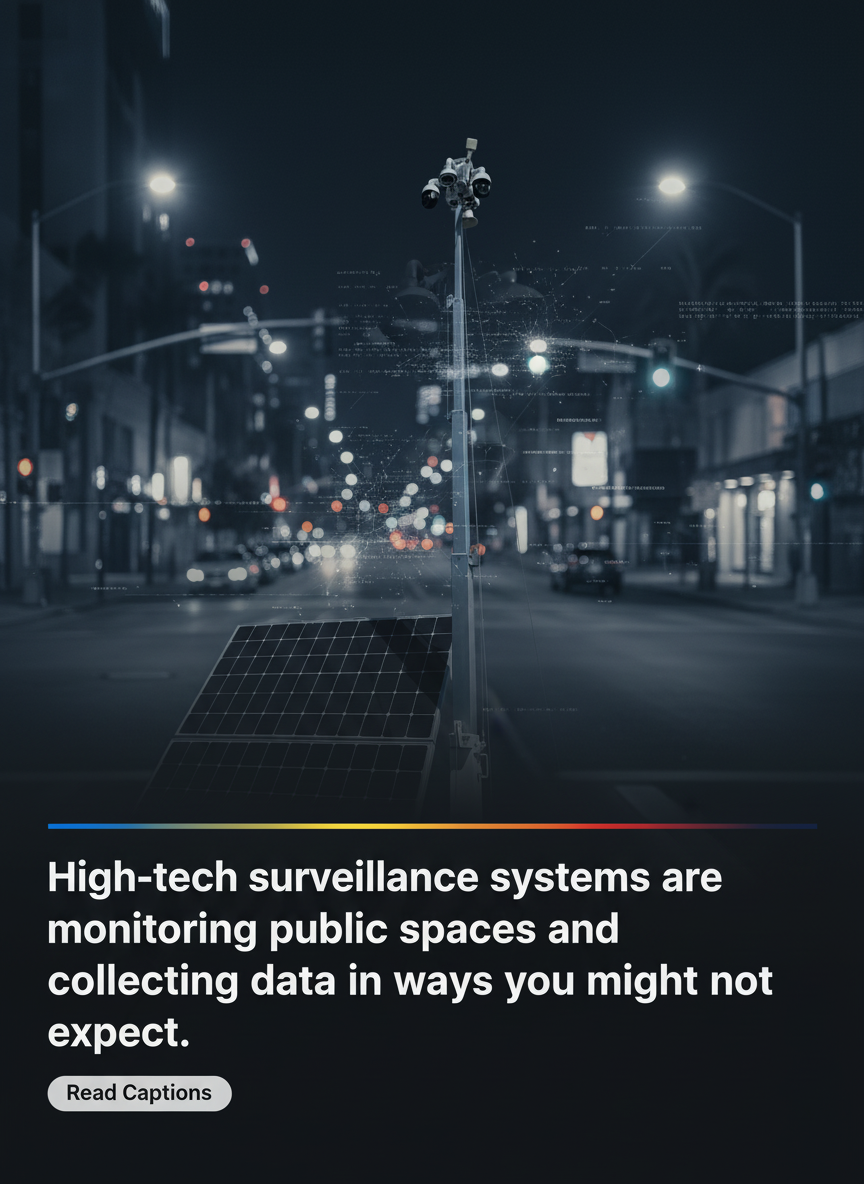
The High-Tech ‘Scarecrows’ Watching Your Every Move — And What They’re Really Being Used For
By News Desk | March 22, 2026
If you have visited a big-box retailer, a local mall, or even a construction site recently, you have likely encountered them: towering, solar-powered sentinels perched on trailers, equipped with flashing blue lights and an array of rotating camera lenses. Dubbed “high-tech scarecrows,” these mobile surveillance units have quietly become the most visible face of 21st-century security, marking a paradigm shift in how public spaces are monitored.
The Rise of the Sentinels
In the era of high-tech security systems, the scope of surveillance technology can often be taken for granted. However, companies like LiveView Technologies (LVT) and LotCop have moved surveillance out of the shadows and into the center of the parking lot. These units, which can be deployed in minutes, are designed to be impossible to ignore.
Equipped with 360-degree high-definition cameras, thermal imaging, and AI-driven software, these trailers do more than just record footage. They are active participants in crime prevention. Using machine learning, the units can distinguish between a stray cat and a person loitering near a restricted area, automatically triggering strobe lights or pre-recorded audio warnings to “deter” potential bad actors before a crime is even committed.
Why Retailers Are Betting Big
The sudden explosion of these mobile units is a direct response to rising retail theft and “smash-and-grab” incidents that have plagued major chains over the last few years. For giants like Walmart, Home Depot, and Lowe’s, the “scarecrow” approach offers a cost-effective alternative to traditional security guards.
“It’s about psychological deterrence,” says security analyst Marcus Thorne. “A camera hidden under the eaves of a building might catch a thief in the act, but a seven-foot-tall tower flashing blue lights tells the thief to go somewhere else entirely. It’s the digital version of a scarecrow in a cornfield—only this one has the ability to call the police and read your license plate.”
Beyond Security: The Data Play
While their primary function is advertised as safety, the “what they’re really being used for” aspect has raised eyebrows among privacy advocates. Beyond catching shoplifters, these units are capable of sophisticated data collection. Many are equipped with Automated License Plate Recognition (ALPR) technology, which can track how often a specific vehicle visits a location or cross-reference plates with law enforcement databases.
There is also the potential for “customer analytics.” By tracking the flow of people and vehicles, retailers can gather valuable data on foot traffic patterns, peak shopping hours, and even the demographics of their visitors. In the digital age, your movements in a parking lot are increasingly being treated as valuable data points.
A Privacy Frontier
The ubiquity of these units has sparked a heated debate regarding the erosion of privacy in public spaces. Critics argue that the “always-on” nature of these systems creates a climate of constant surveillance that could be abused. Unlike fixed city cameras, these mobile units operate in a regulatory “gray zone,” often owned by private companies but sharing data with local police departments through public-private partnerships.
“We are seeing a normalization of military-grade surveillance in the places where we buy our groceries,” says Sarah Jenkins, a digital rights activist. “The line between keeping people safe and tracking their every move is becoming dangerously thin.”
Conclusion: The New Normal
As technology continues to evolve, the high-tech scarecrows are likely here to stay. They represent a new frontier where artificial intelligence, solar power, and physical deterrence meet. For many shoppers, the presence of these flashing towers provides a sense of security in an increasingly uncertain world. For others, they are a chilling reminder that in 2026, someone—or something—is always watching.
As the sun sets over suburban parking lots, the blue lights of these sentinels continue to flicker, a silent testament to the fact that while we may take surveillance for granted, it has never been more focused on us.