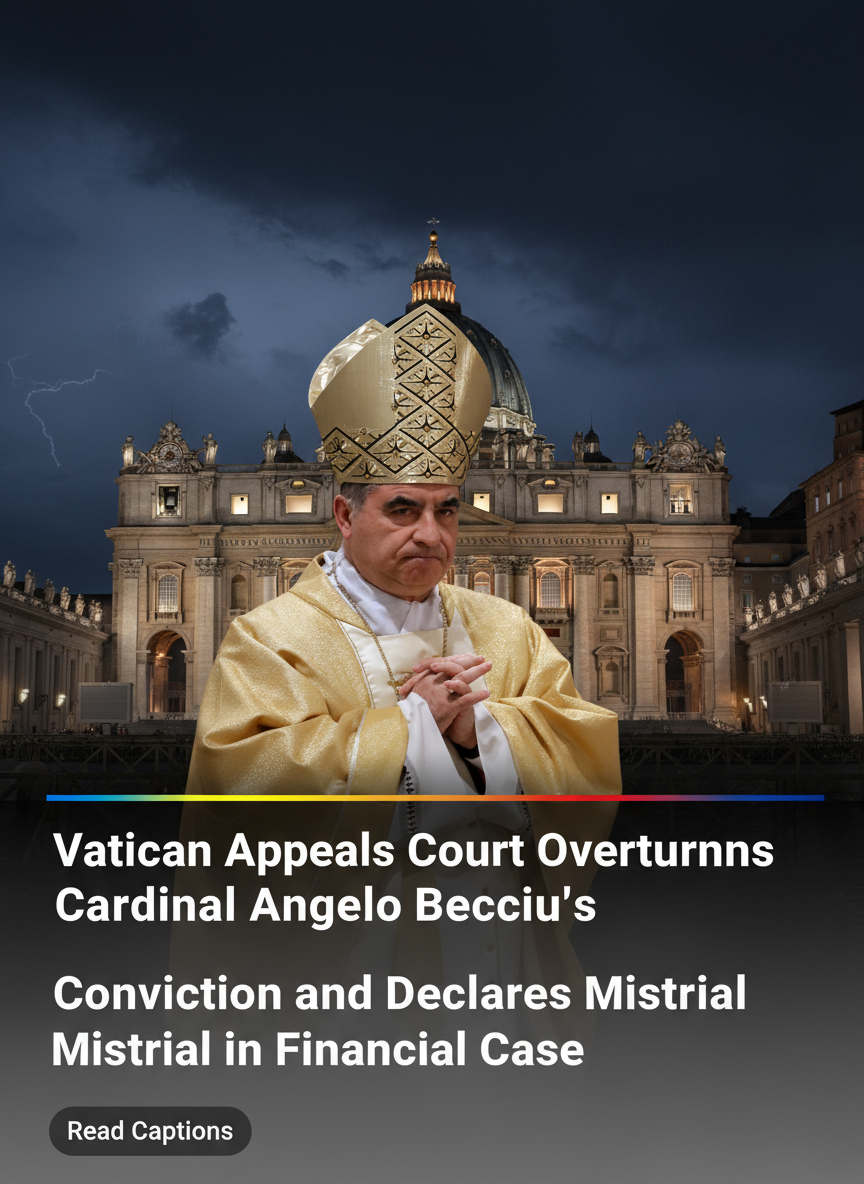
Vatican Appeals Court Overturns Historic Conviction of Cardinal Angelo Becciu in ‘Trial of the Century’ Shock
VATICAN CITY — In a stunning reversal that has sent shockwaves through the Holy See, a Vatican appeals tribunal on Tuesday declared a mistrial in the high-profile financial fraud case against Cardinal Angelo Becciu. The decision effectively vacates the historic conviction of the highest-ranking Catholic prelate ever to face a Vatican criminal court, throwing the papacy’s landmark “trial of the century” into legal limbo.
A Dramatic Reversal
The appeals court’s ruling comes nearly two years after Cardinal Becciu was originally sentenced to five and a half years in prison for embezzlement and conspiracy. The tribunal’s decision to declare a mistrial applies not only to Becciu but also to several other defendants who were ensnared in the sprawling investigation into the Secretariat of State’s botched investment in a luxury London real estate property.
While the full written justification for the tribunal’s decision is expected to be released in the coming days, legal experts suggest that procedural irregularities and defense arguments regarding the violation of due process rights were central to the court’s determination. Throughout the original 30-month trial, defense attorneys repeatedly argued that the prosecution had withheld key evidence and that the summary powers granted to investigators by Pope Francis compromised the fairness of the proceedings.
The ‘Trial of the Century’ Recap
The case, which began in 2021, was seen as a litmus test for Pope Francis’s decade-long effort to bring transparency and accountability to the Vatican’s murky finances. The core of the prosecution centered on the loss-making €350 million investment in a former Harrods showroom in Chelsea, London. Prosecutors alleged that the deal was used to siphon millions of euros from the Holy See into the pockets of outside brokers and through negligent internal management.
Cardinal Becciu, who served as the “Sostituto” (Chief of Staff) at the Secretariat of State from 2011 to 2018, consistently maintained his innocence. He claimed he was a victim of a “machination” and that his actions were always intended to benefit the Church. The December 2023 verdict had marked the first time a Prince of the Church was convicted of financial crimes by a tribunal of lay judges.
A Blow to Vatican Reform Efforts
The declaration of a mistrial represents a significant setback for the Vatican’s judicial system and for the image of Pope Francis’s financial reforms. For years, the Pope has sought to convince international financial watchdogs that the Vatican City State possesses a robust, independent, and modern legal framework capable of policing its own sovereign wealth.
Critics of the initial trial argued that the proceedings were marred by “medieval” legal standards, citing the Pope’s direct intervention in the legal process through four secret decrees that expanded the prosecution’s powers. Today’s ruling may embolden those who claim the Vatican’s judicial infrastructure remains ill-equipped for complex modern financial litigation.
What Lies Ahead
The declaration of a mistrial does not necessarily mean Cardinal Becciu and his co-defendants are permanently exonerated. In many legal systems, a mistrial allows for the possibility of a retrial. However, given the immense cost, length, and reputational damage already incurred by the first trial, it remains unclear whether Vatican prosecutors will seek to bring the case back to the courtroom.
For Cardinal Becciu, who was stripped of his rights as a cardinal (though he retained the title) by Pope Francis prior to the trial, the ruling is a monumental personal and legal victory. Outside the courtroom on Tuesday, supporters of the 77-year-old prelate expressed relief, calling the decision a “triumph of justice” over a flawed investigative process.
As the Vatican grapples with the fallout of this decision, the international community continues to watch closely. The collapse of the conviction raises fundamental questions about the future of accountability within the world’s smallest sovereign state and the enduring legacy of the current papacy’s reform agenda.