Celestial Spectacle: Eid Moon to Join Venus on the Spring Equinox as Ramadan 2026 Concludes
As millions of Muslims worldwide prepare for the conclusion of the holy month of Ramadan, a rare celestial alignment is set to grace the night sky. This year, the sighting of the “Shawwal moon”—which signals the start of Eid al-Fitr—will coincide with the Spring Equinox and a stunning proximity to the planet Venus, offering a breathtaking visual treat for both the faithful and stargazers alike.
The Search for the Crescent: Saudi Arabia’s Moon Sighting
The timing of Eid al-Fitr is traditionally determined by the sighting of the young crescent moon. In Saudi Arabia, the Supreme Court and its dedicated moon-sighting committees are preparing to scan the western horizon on the evening of Friday, March 20, 2025 (the 29th day of Ramadan).
If the slender crescent is visible on Friday evening, Ramadan will consist of 29 days, and Eid al-Fitr will be celebrated on Saturday, March 21. If the moon remains elusive due to atmospheric conditions or orbital positioning, Ramadan will complete a 30-day cycle, pushing the festivities to Sunday, March 22. Given the astronomical calculations for 2026, the weekend of March 20-22 stands as the focal point for global celebrations.
A Rare Celestial Convergence on the Equinox
What makes the 2026 “Eid Moon” particularly special is its timing relative to the Spring Equinox. Occurring on March 20, the equinox marks the moment the sun crosses the celestial equator, signaling the start of spring in the Northern Hemisphere and autumn in the Southern Hemisphere.
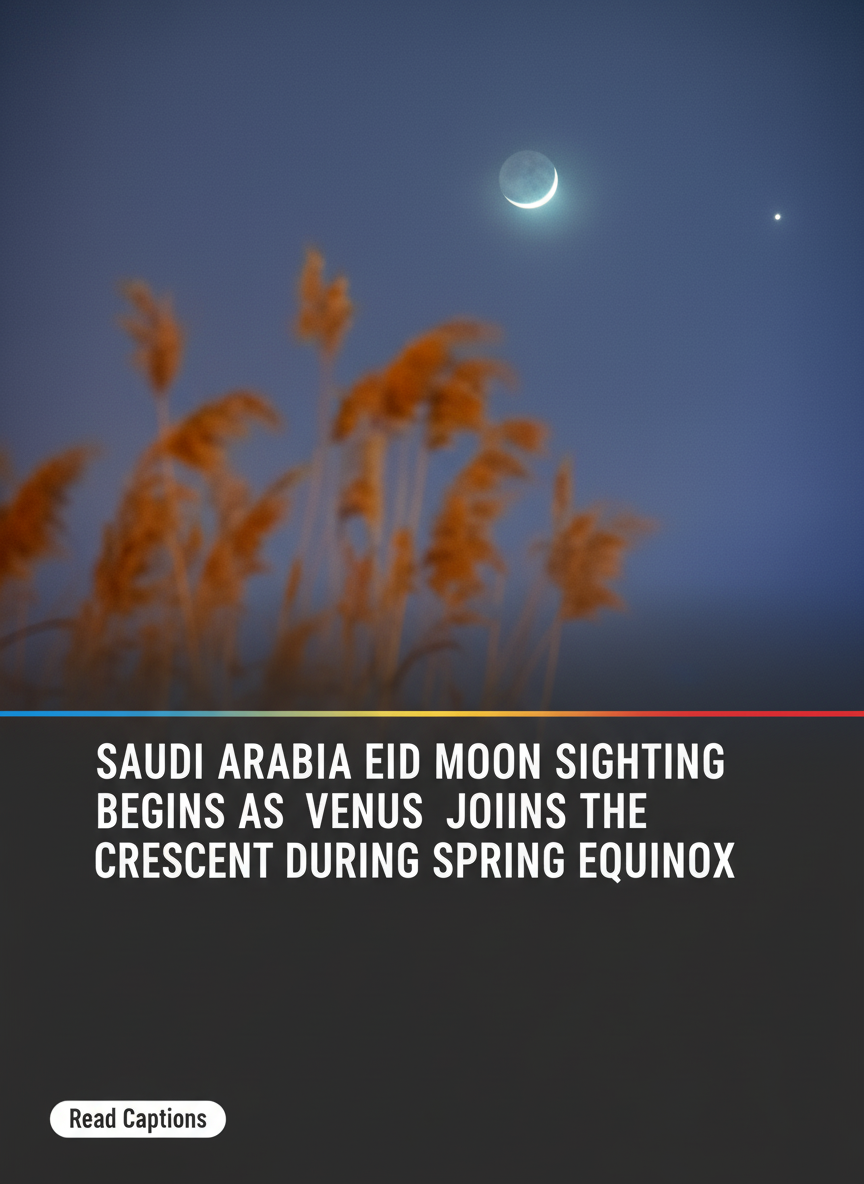
On this specific evening, those looking toward the western sky shortly after sunset will not only be searching for the delicate silver sliver of the new moon but will also be treated to the presence of Venus. Known as the “Evening Star,” Venus will be shining at its near-maximum brilliance, positioned remarkably close to the lunar crescent. This rare alignment creates a “conjunction,” where the brightest planet and the moon appear to dance together in the twilight.
How to Watch: A Guide for Stargazers
For the best view of this astronomical event, experts suggest finding a location with a clear, unobstructed view of the western horizon. Unlike many deep-space phenomena, this alignment will be visible to the naked eye, though binoculars will enhance the view of the “Earthshine” on the moon—a faint glow on the dark limb of the lunar disk caused by sunlight reflecting off the Earth.
The window for viewing will be brief, lasting roughly 30 to 60 minutes after sunset before the moon and Venus follow the sun below the horizon. The proximity of Venus serves as a helpful “celestial lighthouse,” guiding the eyes of observers to the exact spot where the thin Eid crescent is likely to appear.
The Cultural and Spiritual Significance
The end of Ramadan is a period of reflection, gratitude, and community. The sighting of the moon is more than just an astronomical marker; it is a moment of unity for the global Ummah. The addition of a bright Venus and the natural balance of the Spring Equinox adds an extra layer of wonder to the transition from the month of fasting to the “Festival of Breaking the Fast.”
As Saudi Arabia prepares its official announcement, the world watches the skies. Whether viewed through a telescope in a state-of-the-art observatory or with the naked eye from a backyard, the 2026 Eid moon promises to be one of the most visually stunning in recent memory.
Conclusion
As the curtains close on Ramadan 2026, the cosmos seems to be providing its own celebration. The convergence of the Eid moon, the brilliance of Venus, and the astronomical balance of the equinox reminds us of the intricate clockwork of our solar system. For those celebrating, it is a luminous start to Eid al-Fitr; for others, it is a masterclass in the beauty of the night sky.