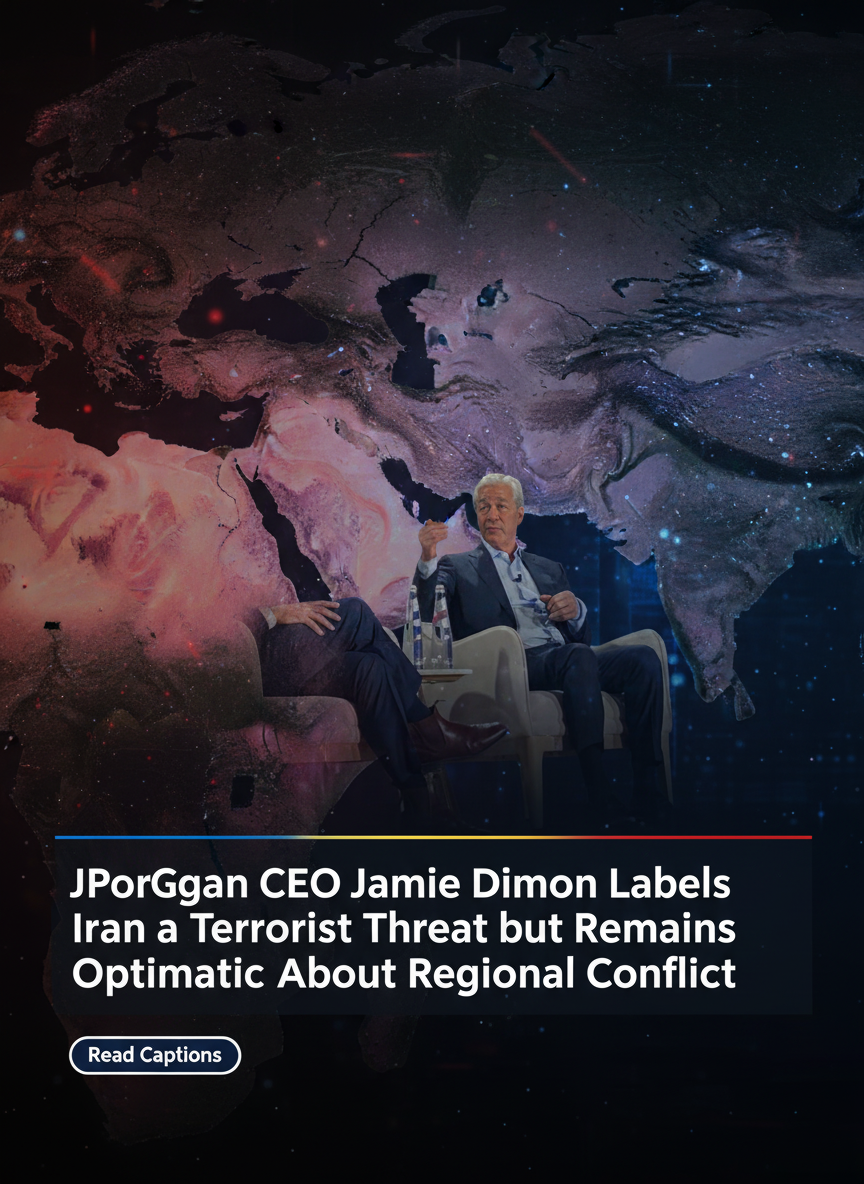
Why JPMorgan CEO Jamie Dimon is ‘a Little Optimistic’ About the Iran War
NEW YORK — In a blunt assessment of global security, JPMorgan Chase CEO Jamie Dimon has labeled Iran a primary “terrorist threat” while simultaneously expressing a surprising degree of cautious optimism regarding the trajectory of the ongoing conflict in the Middle East.
Speaking at a high-level financial summit on Tuesday, the head of the world’s largest bank did not mince words when discussing the geopolitical risks emanating from Tehran. Dimon’s comments come at a time of heightened regional volatility, as the international community grapples with the fallout of sustained military engagements and shifting alliances.
‘An Actual Killing Agent’
During his address, Dimon characterized the Iranian regime not merely as a political adversary, but as a visceral danger to global stability. “Iran is a terrorist threat,” Dimon stated. “This is an actual killing agent.”
His rhetoric underscored the severity of Tehran’s influence through its “Axis of Resistance.” Dimon pointed specifically to the regime’s long-standing strategy of utilizing regional proxy conflicts to exert power. By funding and directing armed militia groups across the Levant and the Arabian Peninsula, Dimon argued, Iran has created a decentralized network of violence that threatens both human life and the flow of global commerce.
“They are not just funding rhetoric; they are funding the mechanics of war,” Dimon added, referencing the sophisticated weaponry and drone technology that have become hallmarks of Iranian-backed operations in the region.
The Case for Cautious Optimism
Despite the grim description of the adversary, Dimon told the audience he remains “a little optimistic” that the current conflict can be contained or resolved without descending into a total global catastrophe. This sentiment, while seemingly at odds with his “killing agent” descriptor, is rooted in several strategic factors.
First, Dimon highlighted the resilience of the United States and its allies. He noted that the coordinated international response to maritime threats and proxy attacks has shown a level of unity that many analysts did not anticipate. This “deterrence by alignment,” as some strategists call it, is a primary reason for his hope.
Second, the JPMorgan chief pointed to the internal economic and political pressures facing the Iranian leadership. He suggested that while the regime remains dangerous, its capacity to sustain a high-intensity, multi-front war is being eroded by international sanctions and domestic unrest. The optimism, therefore, lies in the belief that the regime may eventually be forced to the negotiating table or face systemic collapse.
Geopolitics and the Global Economy
Dimon’s foray into military and geopolitical analysis is not unusual for a CEO who has increasingly positioned himself as a global statesman. In his view, the “Iran war”—referring to the broader shadow conflict and its active flashpoints—is the single most significant risk to the global economy, potentially more disruptive than inflation or interest rate hikes.
“We have to be prepared for a range of outcomes,” Dimon cautioned. “But if the U.S. continues to lead with strength and maintains its energy independence, we can navigate through this darkness. The world is looking for leadership, and despite the threats, I believe we are capable of providing it.”
Conclusion
Jamie Dimon’s dual-track message serves as both a warning and a rallying cry. While he views Iran as a lethal force that must be neutralized, his “optimism” stems from a fundamental belief in Western institutional strength and the inevitability of containment. As markets continue to react to every headline from the Middle East, Dimon’s words provide a window into how the financial elite are pricing in the risks of a world at war.