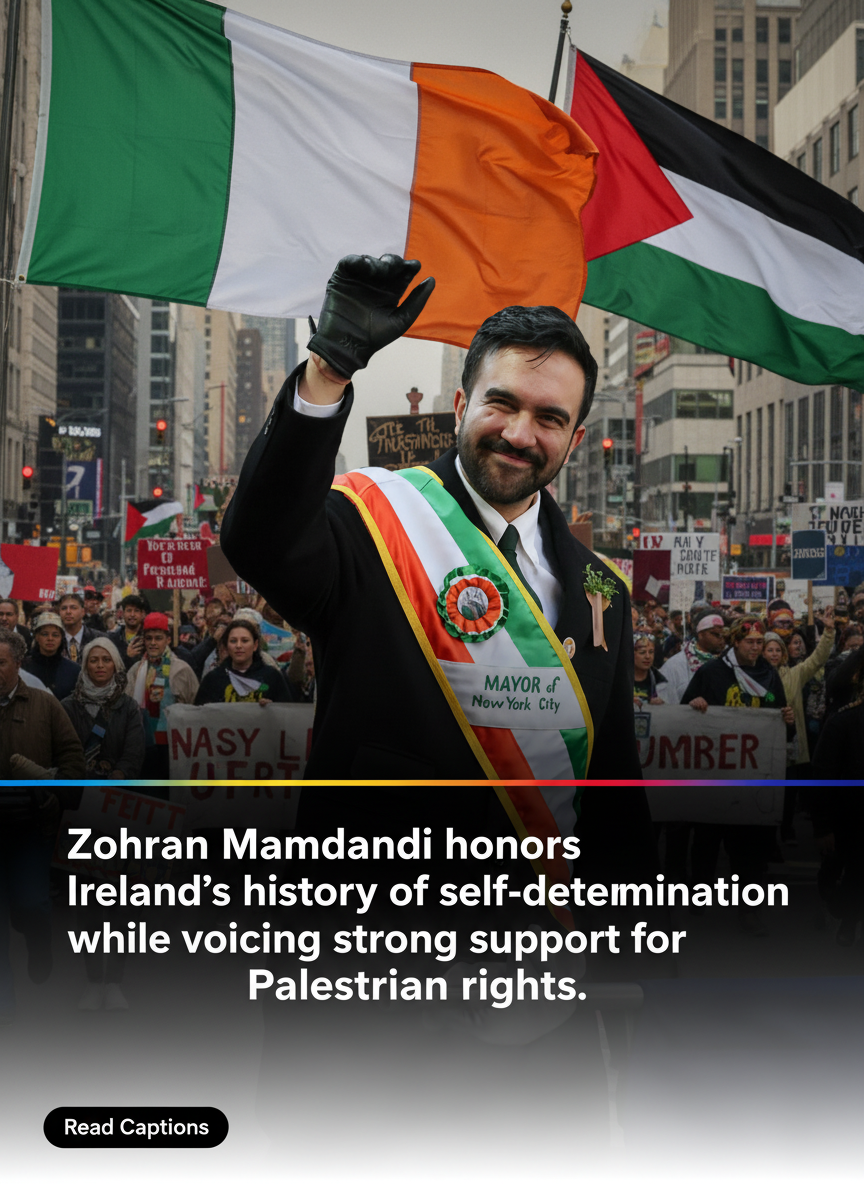
From Dublin to Gaza: Mayor Mamdani’s St. Patrick’s Day Message Draws Historical Parallels
NEW YORK — In a move that blended holiday tradition with contemporary global politics, Mayor Zohran Mamdani utilized his 2026 St. Patrick’s Day address to draw a direct line between the Irish struggle for independence and the current plight of Palestinians. Speaking from the steps of City Hall on Tuesday morning, Mamdani’s remarks signaled a significant departure from the standard celebratory rhetoric of New York City mayors past.
A Shared History of Resistance
While the St. Patrick’s Day parade is typically a venue for celebrating Irish-American heritage and the “Emerald Isle’s” cultural contributions to the five boroughs, Mayor Mamdani focused his message on the political core of Irish history. He lauded Ireland’s long-standing fight for self-determination, framing the nation as a global beacon for those resisting colonial rule.
“Ireland’s journey from the shadows of famine and colonial occupation to a sovereign, thriving republic is not just an Irish story; it is a human story,” Mamdani told the gathered crowd. “It is a history that resonates deeply with those who still seek their own right to exist, to govern themselves, and to live without the presence of foreign military checkpoints—specifically our brothers and sisters in Palestine.”
The Roots of Solidarity
The Mayor’s comments highlight a historical bond that has strengthened in recent years. Ireland has long been one of the most vocal supporters of Palestinian rights within the European Union, a stance rooted in its own 800-year history of British rule. By invoking this connection, Mamdani aimed to contextualize the Palestinian cause not as an isolated Middle Eastern conflict, but as part of a global tradition of anti-colonialism.
Political analysts suggest that Mamdani, the city’s first socialist mayor in the modern era, is intentionally reshaping the city’s diplomatic language. “Mamdani isn’t just marching in a parade; he’s attempting to redefine what international solidarity looks like from the perspective of New York City,” said Dr. Elena Rossi, a political science professor at NYU. “He is tapping into a specific Irish republican tradition that has always seen its struggle as intertwined with other global liberation movements.”
Reaction and Controversy
The Mayor’s speech was met with a mix of enthusiastic cheers from progressive activists and sharp rebukes from more traditional political circles. Several City Council members released a joint statement shortly after the address, criticizing the Mayor for “politicizing a day of cultural unity.”
“St. Patrick’s Day is a time to celebrate the Irish-American experience and the bonds that tie New York to Ireland,” the statement read. “To use this platform to weigh in on the complexities of the Middle East is divisive and detracts from the spirit of the holiday.”
Conversely, advocates for Palestinian rights praised the Mayor for his “moral clarity.” Organizers from several Irish-American labor unions also defended the speech, noting that the “spirit of 1916” (the Easter Rising) has always been about the universal right to freedom.
A New Era at City Hall
Mamdani’s choice to mention Palestinians during a quintessential New York celebration reflects the shifting demographics and political priorities of the city’s electorate. As the younger generation of New Yorkers increasingly aligns with global social justice movements, the Mayor’s rhetoric appears to be a calculated effort to bring those international concerns to the forefront of local governance.
As the bagpipes faded and the parade moved up Fifth Avenue, the conversation shifted from the Mayor’s words to the broader implications for his administration. Whether this message of shared struggle will bridge divides or deepen them remains to be seen, but one thing is clear: under Mayor Mamdani, the status quo of New York City politics is a thing of the past.
Reported by the City Desk. For more updates on New York City politics, subscribe to our daily newsletter.