Amazon’s Zoox Accelerates: San Francisco Service Expands as Robotaxi Testing Hits Austin and Miami
SAN FRANCISCO — The autonomous vehicle landscape is shifting gears as Zoox, the self-driving subsidiary of Amazon, announced a significant expansion of its operations on Tuesday. In what leadership is describing as a “milestone moment” for the company, Zoox is broadening its footprint in its home base of San Francisco and Las Vegas while simultaneously launching testing phases in two major new markets: Austin and Miami.
The move signals a bold confidence in the company’s technology at a time when the robotaxi industry faces heightened regulatory scrutiny and intense competition. By moving into Texas and Florida, Zoox is not just increasing its mileage; it is diversifying the environments in which its artificial intelligence must learn to navigate.
Strengthening the West Coast Stronghold
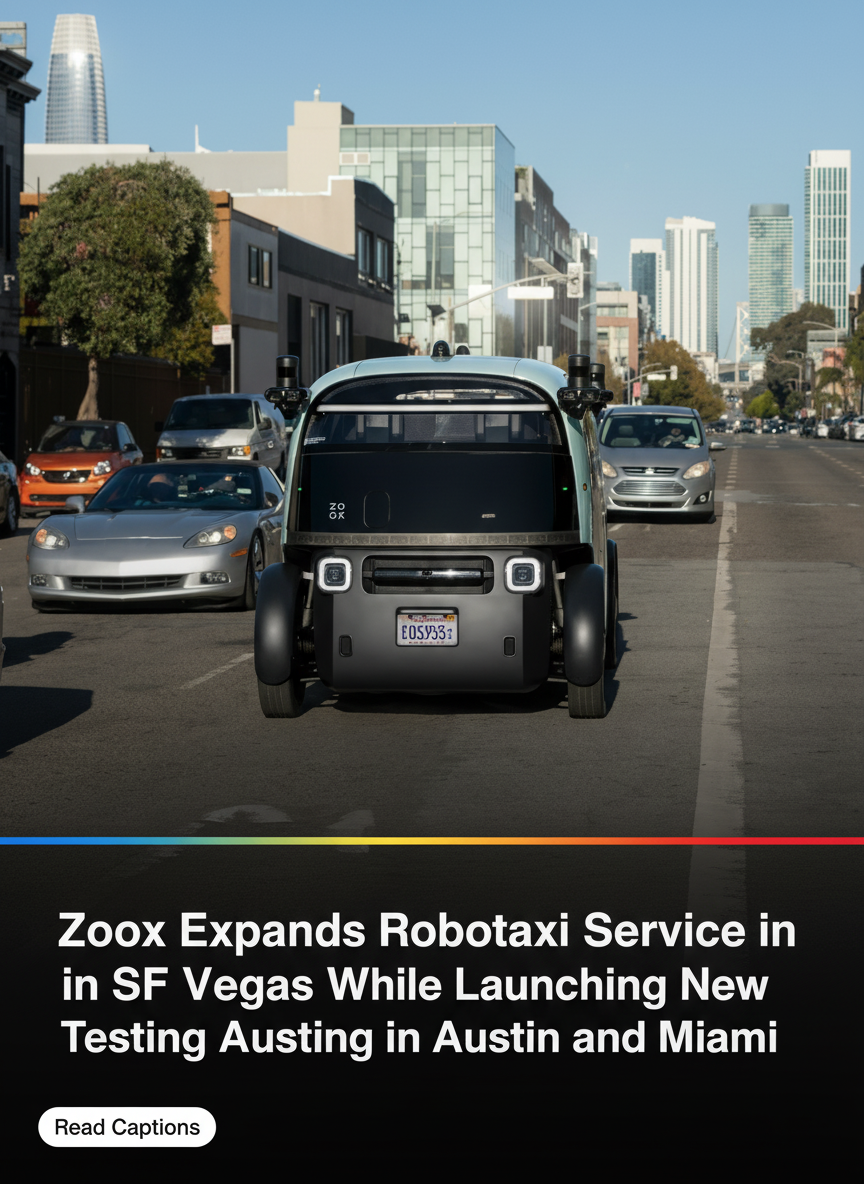
In San Francisco and Las Vegas—cities where Zoox has already established a presence—the expansion will involve a larger fleet and an increased operational area. This growth aims to move the company closer to its goal of providing a fully commercialized, rider-ready service. Currently, Zoox operates a fleet of retrofitted Toyota Highlanders to gather data, alongside its flagship “purpose-built” vehicle, which features no steering wheel or traditional driver’s seat.
The expansion in San Francisco is particularly noteworthy given the city’s complex topography and dense urban traffic. By increasing its presence here, Zoox is doubling down on its ability to handle one of the most challenging driving environments in the United States.
New Horizons: Austin and Miami
The decision to enter Austin and Miami marks Zoox’s first foray into the Southern and Southeastern United States. Both cities offer unique challenges: Austin is known for its unpredictable traffic patterns and high density of cyclists, while Miami provides a tropical climate with frequent heavy rain and a unique local driving culture.
“Austin and Miami offer new variables that will help us refine our autonomous driving stack,” a company spokesperson noted. Testing in these locations will initially utilize the retrofitted SUV fleet with human safety drivers behind the wheel to map the cities and monitor system performance before any autonomous-only operations are considered.
A Unique Approach to Autonomy
What sets Zoox apart from competitors like Waymo is its commitment to a “carriage-style” interior. Unlike traditional vehicles modified for autonomy, Zoox’s custom-built robotaxi allows passengers to sit face-to-face. This design philosophy emphasizes that the vehicle is a mobile space for socializing or working, rather than just a modified car.
However, the road to total autonomy is not without obstacles. The industry at large has faced setbacks over the past year, including safety incidents involving other providers that have led to temporary permit suspensions. Zoox’s methodical “testing-first” approach in Austin and Miami suggests a strategy focused on long-term safety and public trust over rapid, unchecked scaling.
The Road Ahead
As Zoox begins its journey into these new metropolitan hubs, the eyes of the tech and transportation worlds will be watching. The company has not yet provided a specific date for when the general public in Austin or Miami will be able to hail a ride, but the expansion of the testing fleet is a necessary precursor to commercial viability.
With Amazon’s significant backing and a growing geographic reach, Zoox is positioning itself as a primary contender in the race to redefine urban mobility. For residents of San Francisco, Las Vegas, and now Austin and Miami, the sight of a sensor-laden vehicle navigating their streets is becoming a glimpse into the future of transportation.